Resources / Celestial timing
The 24-Hour Clock
A clock whose hand goes round once in a day, as the Earth does. Round the dial lies the day's light for the place you give it: day, the three twilights and night, each where the hand will meet it. Beside it the same moment is read on four other clocks: universal, mean solar, apparent solar and sidereal.
It opens on your own time and place and runs live. Set a date, a time or another city to see any day of the year anywhere on Earth.
Setting the clock for your time and place
The tradition
The count of twenty-four is Egyptian: twelve parts to the night and twelve to the day. For most of antiquity those parts were unequal, stretching and shrinking with the season. The astronomers needed hours that stayed the same, and reckoned in what Ptolemy calls equinoctial hours: twenty-four equal ones to a day and a night, each the length an hour has at the equinox.
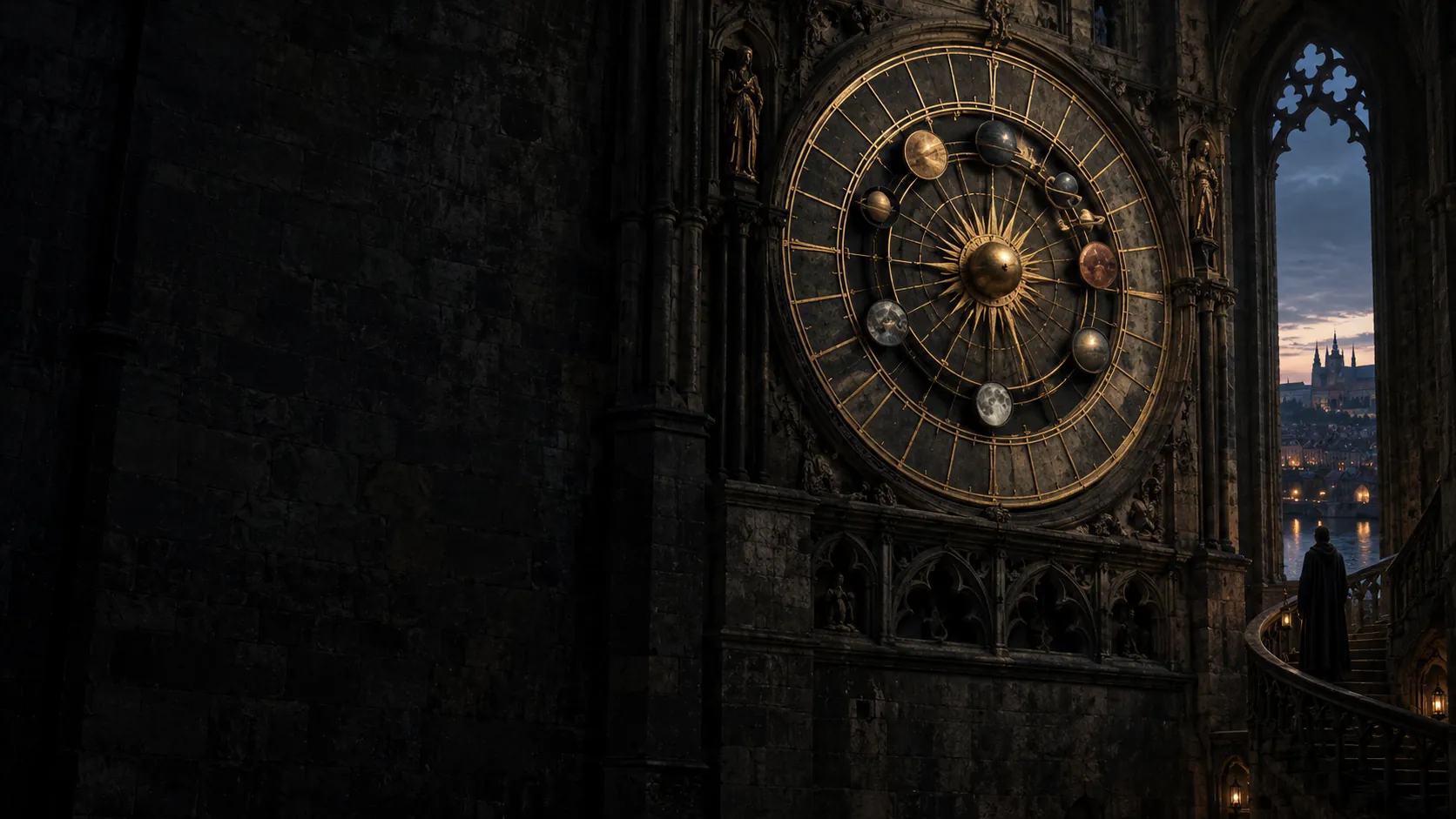
The first public clocks often showed all twenty-four on one dial. The face Paolo Uccello painted for the clock of Florence Cathedral in 1443 is a ring of twenty-four hours, and the astronomical clock of Prague, of 1410, carries one too. Counting twice to twelve won out on household clocks, but the single count never left the observatory, the railway timetable or the ship's log, and the international standard for writing times, ISO 8601, numbers the hours 00 to 23.
A dial of twenty-four has one virtue a dial of twelve lacks: the hand goes round once for one turn of the Earth. Set noon at the top and the hand is where the Sun is, high at midday and under the world at midnight, which is how the old astronomical clocks were read.
Reading the instrument
- The long gold hand turns once in the day and carries a small Sun in the coloured band. The pale hand is the minute hand, read against the inner track, and the red hair is the seconds while the clock is running live.
- The band is the day's light for your place and date. Gold is day, from sunrise to sunset. Either side of it come civil, nautical and astronomical twilight, the Sun 6°, 12° and 18° below the horizon, and what remains is night. Near midsummer in high latitudes the dark bands thin and vanish; inside the polar circles the gold closes into a full ring, or disappears.
- The panel beside the dial reads the same instant on four other clocks. Universal Time is the world's common clock. Mean solar time is a steady clock set to your own meridian. Apparent solar time is what a sundial there would read. Sidereal time is the clock of the stars: it says which hour of right ascension is crossing your meridian, and gains a little under four minutes a day on the Sun.
- Choose midnight at the top to read the day from 0 round to 24, as a timetable does.
Where it descends from
- Ptolemy, Almagest
- The equal, or equinoctial, hours in which the astronomers reckoned: twenty-four to a day and a night.
- US Naval Observatory, Rise, Set, and Twilight Definitions
- Sunrise and sunset by the Sun's upper edge, and civil, nautical and astronomical twilight at 6°, 12° and 18°.
- ISO 8601
- The international standard for writing dates and times, with the hours counted 00 to 23.
- Jean Meeus, Astronomical Algorithms (2nd ed., 1998)
- The Sun's place, the sidereal time and the times of rising and setting.
What this does not claim
The clock is your device's own, so it is as right as that is. Sunrise and sunset are for the Sun's upper edge on a level sea horizon under ordinary air, good to within a few seconds below 65° of latitude; hills, height and unusual weather move the real thing by a minute or more. The twilights are angles of the Sun, not a promise of how dark the sky will be. Universal Time here is UTC, which stays within a second of the Earth's own turning. The zone and its summer time come from your browser.
Continue
Read the subject