Four Branches
One sky, four questions: the same machinery answers each differently.
Natal — the birth momentHorary — the question's momentElectional — choosing a momentMundane — nations and epochs
As above
A symbolic cosmology relating celestial order to earthly life.
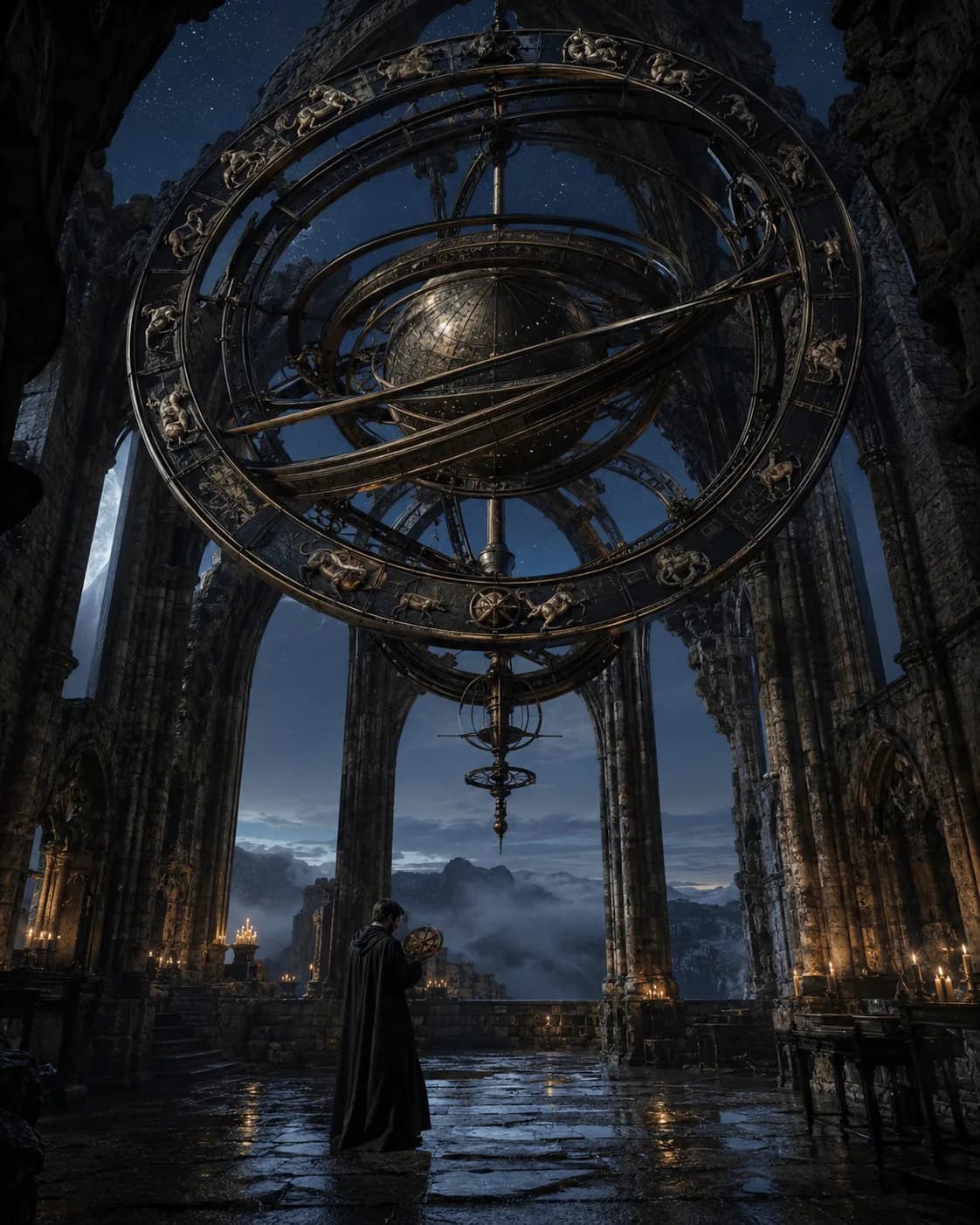
The armillary is not a picture of the sky but a model of it — rings for the ecliptic, the equator, the meridian. To read a chart is to hold that machine in mind and ask where a body stood inside it.
Topic archive
A dossier on the oldest continuous science of correspondence: omen lore to horoscopy, the great systems east and west, and the instruments this archive keeps for working them.
The Observatory Stair
Astrology is presented historically, philosophically, and critically as part of sacred cosmology.
Astrology is not one system but a family of them, descended from Mesopotamian omen-watching through a Hellenistic synthesis that gave the West its horoscope: ascendant, houses, aspects, and lots, assembled in Greco-Roman Egypt around the second century BCE.
The family then divides. India received the Hellenistic material and grew Jyotisha around the sidereal zodiac and the lunar mansions; China built an astrology on entirely different foundations — no ecliptic zodiac at all, but stems, branches, and the five phases; the Arabic world systematized what Rome let slip and handed it back to Europe twice over.
The page holds the working parts: the four branches of practice, the tropical and sidereal zodiacs, the glyphs, the house systems, and the chart shapes — with the atlas below drawing what prose describes, and the archive's own instruments linked where they compute it.
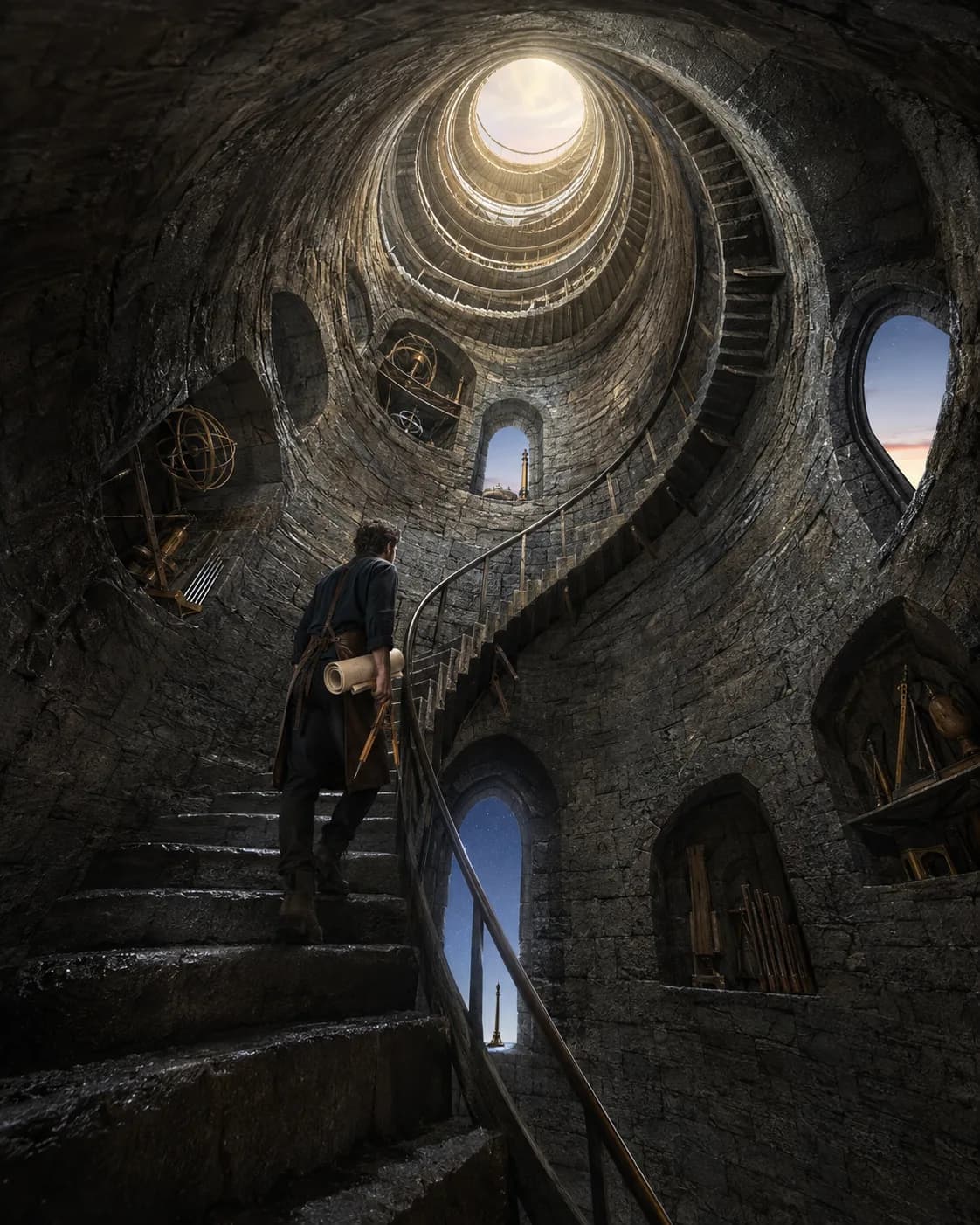
Before the telescope, an observatory was a stair and a sightline: armillaries, quadrants, and rules kept in niches, and a long climb toward the open circle of sky. The astrology in this archive is the working knowledge such towers were built around.
The Atlas
Seven instruments of literacy: the glyphs a chart is written in, the arithmetic that generates the twelve signs, the houses and their meanings, the systems that argue over where their cusps fall, the aspects that let planets speak to one another, the shapes a whole chart makes at a glance, and the correspondence spine with the essential dignities. The wheels are schematic — they show how each system cuts the circle, not a cast chart. For real computation, the archive’s instruments are linked at the end.
Seven classical planets, three moderns, the lunar nodes, and the twelve signs — the complete alphabet of a chart.
The zodiac is not a list of twelve personalities but a product of two smaller alphabets: four elements crossed with three modes. Most sign “keywords” are this arithmetic said slowly — Aries is nothing more mysterious than fire behaving cardinally.
| Element | Cardinalinitiates the season | Fixedsustains its middle | Mutablehands it over |
|---|---|---|---|
| Firevital spark, spirit, initiative | Aries | Leo | Sagittarius |
| Earthsubstance, sense, endurance | Capricorn | Taurus | Virgo |
| Airrelation, speech, exchange | Libra | Aquarius | Gemini |
| Waterfeeling, memory, dissolution | Cancer | Scorpio | Pisces |
Signs describe how; houses say where — twelve departments of a life, counted counterclockwise from the ascendant. The shaded quarters are the angular houses, where the chart touches its own frame and planets act at full strength; each gold glyph sits in the house where tradition says that planet rejoices— the doctrine of the joys, which is also where the houses’ oldest names come from.
Angular · shaded — succedent follow — cadent fall away.Joys: ☿︎ I · ☽︎ III · ♀︎ V · ♂︎ VI · ☉︎ IX · ♃︎ XI · ♄︎ XII
IVitaLife
angular · joy of ☿︎ Mercury
The helm: body, temperament, appearance — the self that arrives before anything happens to it.
IILucrumGain
succedent
Possessions and livelihood: what the life holds onto, and what holds it up.
IIIFratresBrothers
cadent · joy of ☽︎ Moon · “the Goddess”
Siblings, neighbours, short roads, letters — the daily circuit of the known.
IVGenitorThe Parent
angular
Parents, home, land, and the grave: foundations at the bottom of the sky, where things begin and are buried.
VNatiChildren
succedent · joy of ♀︎ Venus · “Good Fortune”
Children, pleasure, art, play — what the life makes because it delights to.
VIValetudoHealth
cadent · joy of ♂︎ Mars · “Bad Fortune”
Illness, labour, service, and the beasts that work: the body's frictions and the work done under another's direction.
VIIUxorThe Spouse
angular
Marriage and partnership — and the open rival: everyone met exactly at eye level.
VIIIMorsDeath
succedent
Death, inheritance, and other people's goods: what crosses into the life from beyond its control.
IXIterThe Journey
cadent · joy of ☉︎ Sun · “God”
Long travel, religion, divination, higher learning — everything sought far from home.
XRegnumThe Kingdom
angular
Honours, authority, the public summit: the visible top of the chart and of the life.
XIBenefactaGood Deeds
succedent · joy of ♃︎ Jupiter · “Good Spirit”
Allies, patrons, friendship, hope — help that arrives because it was earned or loved into being.
XIICarcerThe Prison
cadent · joy of ♄︎ Saturn · “Bad Spirit”
Confinement, exile, hidden enemies, self-undoing — and the retreats where all of that is faced.
Houses assign the sky’s twelve departments of life. Systems differ on what exactly is divided — signs, the ecliptic, time, or space — and charts move house when the system changes. The bright lines mark the angles where quadrant systems pin their frame.
Whole sign
divides signs themselves
The rising SIGN is the first house entire; every sign is one house. The oldest system, standard in Hellenistic and Indian practice, revived widely since the 1990s.
Equal
divides the ecliptic, from the ASC
Twelve equal houses measured from the ascendant DEGREE. The midheaven floats free of the tenth cusp.
Porphyry
divides each quadrant in thirds
The simplest quadrant system: each quarter between the angles is cut into three equal parts. Third century, still in use.
Placidus
divides diurnal time-arcs
Divides the TIME a degree spends between horizon and meridian. The default of most modern software; fails at polar latitudes.
Koch
divides ascension times of the birthplace
A twentieth-century time-arc method computed from the birthplace's own horizon. Popular in German-speaking practice.
Regiomontanus
divides the celestial equator
Divides the celestial equator equally and projects to the ecliptic. The house system of Lilly and classical horary.
Campanus
divides the prime vertical
Divides the prime vertical — the great circle through east point, zenith, and west point — into equal lunes.
Aspects are how planets address one another: each is a whole-number division of the circle, which is why astrologers speak of them as harmonics. The five Ptolemaic aspects descend from sign geometry — trines join signs of one element, squares signs of one mode — and the older doctrine counted them sign to sign before degrees entered it. An orb is the allowance either side of exactness; a planet moving toward perfection of an aspect is applying, and its promise is still ahead — moving away, it is separating, and the matter is already done.
Conjunction
0° · the circle undivided
Ptolemaic · orb ~8–10°
Two planets fused into one working function. Neither easy nor hard in itself — its temper is entirely the temper of the planets joined.
Semisextile
30° · the circle ÷ 12
minor · orb ~2°
Adjacent signs: neighbours that share no element or mode. A mild, nagging unlikeness more felt than seen.
Sextile
60° · the circle ÷ 6
Ptolemaic · orb ~4–6°
Fire with air, earth with water: compatible temperaments. Opportunity rather than gift — ease that must be invited to act.
Square
90° · the circle ÷ 4
Ptolemaic · orb ~7–8°
Signs of the same mode collide at cross-purposes. The productive crisis: friction that builds exactly the strength it demands.
Trine
120° · the circle ÷ 3
Ptolemaic · orb ~8°
Same element, effortless current. The chart's given talents — and, undisturbed, its laziest places.
Quincunx
150° · the circle ÷ 12 × 5
minor · orb ~2–3°
No shared element, mode, or polarity: the blind spot. Perpetual adjustment between things with no common language.
Opposition
180° · the circle halved
Ptolemaic · orb ~8–10°
Full awareness across an axis: confrontation, projection, partnership. What the square forces, the opposition negotiates.
Before reading any single placement, Marc Edmund Jones taught reading the whole distribution at once. His seven patterns — published in the Guide to Horoscope Interpretation(1941), and built for the ten-planet chart Pluto’s discovery had just completed — treat the gestalt of a nativity as its first sentence: where the planets gather, where they leave the wheel bare, and which single body, if any, the geometry appoints to lead. The shaded arc marks the occupied stretch; the pale dot marks that appointed planet.
Bundle
keynote · Concentration
All ten planets within about 120° — the span of a trine.
The rarest pattern. Everything the chart has is gathered into one department of the sky, and the life tends to match: a specialist temperament that digs one channel deep rather than many shallow, with limited patience for whatever falls outside it.
leading planetThe leading planet — first of the group by clockwise rotation — sets the agenda the whole cluster serves. Two-thirds of the wheel is empty; what the bundle ignores is as diagnostic as what it holds.
Bowl
keynote · Self-containment
All ten planets within one half of the wheel (~180°).
A hemisphere occupied and a hemisphere bare: the life carries its own sources and feels the missing half as a question. Jones read the bowl as self-contained purpose — something held that must eventually be carried across to the empty side.
cutting planetThe cutting planet, at the clockwise edge of the group, leads the whole formation and describes how the person advances into the empty hemisphere. The rim of the bowl — which houses it spans — shows where the holding happens.
Bucket
keynote · Direction
Nine planets in one half; a single planet alone in the other.
A bowl with an outlet. The isolated planet becomes the handle through which everything the other nine gather is poured, and the life organizes itself around that point of application — cause, craft, mission, or grievance.
the handleEverything rides on the handle: its sign, house, and aspects govern the discharge of the whole chart. A handle conjunct the group's midpoint opposition is the pattern at its purest.
Locomotive
keynote · Drive
Two-thirds of the wheel occupied (~240°); an empty trine.
Jones' figure of executive momentum: the empty trine registers as a felt lack, and the chart mobilizes around solving it. Self-starting, problem-hungry, with power delivered unevenly — like a wheel driven from one point.
the engineThe engine — the planet that leads the train clockwise into the empty trine — is the chart's driver and its point of greatest torque. The middle of the empty trine names the prize the drive is secretly aimed at.
Seesaw
keynote · Negotiation
Two opposing groups, separated by two gaps of 60° or more.
A life conducted between two camps: two sets of commitments that face each other across the wheel and refuse to merge. The temperament weighs, compares, alternates — capable of real perspective, and of permanent postponement.
where to lookThe oppositions that bridge the two groups are the working axes of the chart. The heavier cluster is the home base; the lighter one is the counterweight the life keeps returning to pick up.
Splay
keynote · Individuality
Three uneven clusters — a tripod, often braced by a grand trine.
Energy spiking in three distinct departments with real gaps between: the tripod stands on its own arrangement and resists schedule, category, and other people's priorities. Jones read it as rugged, ineradicable individuality.
where to lookRead the three legs as a standing structure: the midpoint of each cluster names a footing, and any grand trine linking them is the pattern's brace — self-sufficiency built into the geometry.
Splash
keynote · Breadth
Planets distributed around the whole wheel; no gap much over 60°.
The opposite of the bundle: interests sown across every quarter of the sky. At best a genuine universality — many rooms lived in comfortably; at worst the classic diffusion of a life spread one planet deep everywhere.
where to lookWith no leading planet to appoint, look for any tight conjunction to act as a gathering point, and fall back on the balance of elements and modes to find where the scatter secretly leans.
The boundaries are judgment calls, not measurements: real charts are often hybrids, and a near-miss — a bowl with one straggler, a locomotive missing its gap by a few degrees — is read as the nearest pattern with the deviation noted. Jones would say the deviation is where the interpretation starts.
The seven classical planets in Chaldean order, with the attributions the whole Western system hangs from — now including the four essential dignities. A planet in its domicile rules the ground it stands on; in exaltation it is an honoured guest; in detriment, opposite its home, it works in a place built on contrary principles; in fall, opposite its exaltation, its dignity is inverted. Condition first, meaning second: this is the oldest rule of judgment. The full tables live in the correspondence explorer.
| Planet | Day | Metal | Domicile | Exaltation | Detriment | Fall |
|---|---|---|---|---|---|---|
| Saturn | Saturday | Lead | Capricorn · Aquarius | Libra | Cancer · Leo | Aries |
| Jupiter | Thursday | Tin | Sagittarius · Pisces | Cancer | Gemini · Virgo | Capricorn |
| Mars | Tuesday | Iron | Aries · Scorpio | Capricorn | Taurus · Libra | Cancer |
| Sun | Sunday | Gold | Leo | Aries | Aquarius | Libra |
| Venus | Friday | Copper | Taurus · Libra | Pisces | Aries · Scorpio | Virgo |
| Mercury | Wednesday | Quicksilver | Gemini · Virgo | Virgo | Sagittarius · Pisces | Pisces |
| Moon | Monday | Silver | Cancer | Taurus | Capricorn | Scorpio |
Work it, not just read it
Everything above is computed live by the archive’s instruments:
The Ladder of the Planets
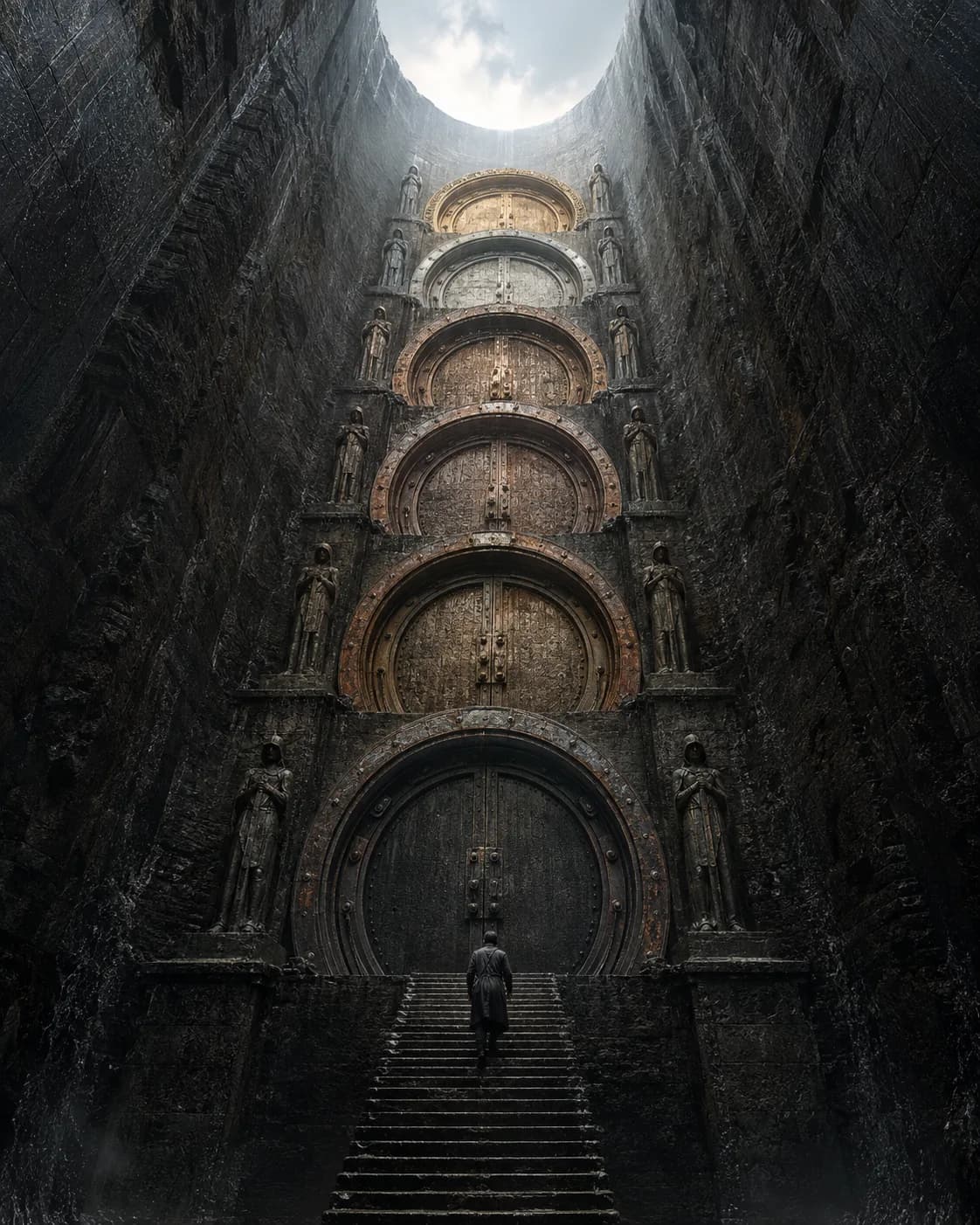
Celsus describes a mystery ladder of seven gates, each of a different metal — lead for Saturn, tin for Venus, iron for Mars, up to gold for the Sun. The planets were not distant objects but stations: something the soul passes through, in both directions.
Dossier
Four Branches
One sky, four questions: the same machinery answers each differently.
Two Zodiacs
Tropical measures from the equinox; sidereal from the stars. They agreed around 285 CE and have drifted a degree every 72 years since.
Aetherica Use
This topic is the reading room for the archive's largest instrument suite.
Cosmology / Metaphysics
The synthesis that invented the horoscope: ascendant, twelve places, aspects, lots, sect, and time-lords, worked in Greco-Roman Egypt and codified by Ptolemy and Vettius Valens.
System Architecture
Representative Texts
A scanning view of the page's major systems, with each tradition kept distinct before deeper archive links, diagrams, and source notes are added.
| System | Period | Architecture | Texts |
|---|---|---|---|
| Hellenistic astrology | 2nd century BCE-7th century CE | Whole-sign houses -> Sect: day and night charts -> The lots, Fortune first -> Time-lord periods | Ptolemy, Tetrabiblos, Vettius Valens, Anthology, Dorotheus, Carmen Astrologicum |
| Jyotisha (Indian) | 2nd century CE-present | Sidereal zodiac with ayanamsa -> Nakshatras — the lunar mansions -> Vimshottari dasha periods -> Divisional (varga) charts | Yavanajataka, Brihat Parashara Hora Shastra, Varahamihira, Brihat Samhita |
| Chinese astrology | Han dynasty-present | Stems and branches -> The sixty-year cycle -> Five phases, not four elements -> Four Pillars (BaZi) | Han shu astronomical treatises, Yuan Hai Zi Ping |
| Perso-Arabic and medieval Latin | 8th-17th century | Essential and accidental dignity -> Horary judgment -> Great conjunction cycles -> Quadrant house division | Masha'allah, On Reception, Abu Ma'shar, Great Introduction, Bonatti, Liber Astronomiae |
| Modern and psychological | 1890-present | Character as destiny -> Outer planets as generational -> Midpoints and harmonics -> The traditional revival | Alan Leo, The Art of Synthesis, Rudhyar, The Astrology of Personality, Project Hindsight translations |
The vocabulary this dossier uses, with the register each definition belongs to. Terms the archive has spoken about link into transcript search; terms treated more fully on this page point there instead.
Hellenistic
Hellenistic
Sanskrit
Sanskrit
Each period is drawn to its extent on one shared axis, so a three-hundred-year epoch runs three times the length of a hundred-year one. The boundaries are conventional rather than exact: a bar marks where the surviving evidence sits, not the year a tradition began or stopped. The empty stretches are part of the record — but a gap here means this dossier holds nothing in that interval, not that nothing happened in it.
c. 1800-1000 BCE
1800 BCE – 1000 BCE
Mesopotamian scholars compile celestial omens — eclipse, halo, planet rising — into the great series Enuma Anu Enlil: seventy tablets of if-then statements linking sky to kingdom. Astrology begins as state intelligence, not personal character.
Fixed points
Gap · 1000 BCE – 410 BCE · 590 years
410 BCE
410 BCE
A cuneiform tablet records planetary positions for a child born late in the fifth century — the earliest known natal horoscope. The sky's attention turns from the king to the individual.
Fixed points
Gap · 410 BCE – 150 BCE · 260 years
2nd century BCE-2nd century CE
150 BCE – 200 CE
In Ptolemaic and Roman Egypt the Babylonian zodiac meets Egyptian decans and Greek geometry: ascendant, twelve places, aspects, lots, and sect appear together as a working system — the horoscope as the West still recognizes it.
Fixed points
c. 150
150 CE
The astronomer of the Almagest writes astrology's most durable defense: a natural-philosophical account of celestial influence that will carry the art through fourteen centuries of respectability.
2nd-6th century
150 CE – 600 CE
The Yavanajataka — 'sayings of the Greeks' — carries Hellenistic horoscopy to India, where it fuses with the nakshatra tradition and the sidereal frame into Jyotisha: the same bones, a different living body.
Fixed points
Gap · 600 CE – 750 CE · 150 years
750-1000
750 CE – 1000
Baghdad's translators and masters — Masha'allah, Sahl, Abu Ma'shar — systematize horary, perfect electional method, and build mundane astrology on Jupiter-Saturn conjunctions. Most of what medieval Europe knew, it learned from these books.
Fixed points
Gap · 1000 – 1100 · 100 years
1100-1300
1100 – 1300
Translation from Arabic restores astrology to the schools; it enters medicine, court, and calendar. Bonatti writes the Latin summa, and cathedral sculpture puts the zodiac over the doors.
Gap · 1300 – 1450 · 150 years
1450-1650
1450 – 1650
Print scatters ephemerides and almanacs; every court keeps an astrologer; Lilly's Christian Astrology gives English its horary classic in 1647 — while the new astronomy quietly removes the cosmology the art had rested on.
Fixed points
1650-1890
1650 – 1890
Astrology loses the universities and survives in almanacs and among surveyors of the curious. The practice thins to sun-sign fortune-telling's ancestors — but the texts wait.
1890-1930
1890 – 1930
Alan Leo rebuilds astrology around character — 'character is destiny' — and mass-produces it by mail; prosecuted twice under the Vagrancy Act, he moves the art decisively from event-prediction toward psychology. In 1930 the modern sun-sign column is born.
Fixed points
1936-1980
1936 – 1980
Rudhyar reads the chart as a seed-pattern of individuation; Jung uses synchronicity to give correspondence a modern name; Ebertin's midpoints and the Hamburg school re-engineer the geometry. The chart becomes a mirror more than an oracle.
Fixed points
1993-present
1993 – present
Project Hindsight begins translating the Hellenistic corpus; whole-sign houses, sect, and time-lords return to working practice. For the first time, the tradition's whole depth — Babylonian to modern — is in print at once.
Fixed points
c. 300 BCE
Babylonian priest credited with carrying the omen tradition to the Greek world — the legendary hinge between Mesopotamia and the Hellenistic synthesis.
c. 100-170
Author of the Tetrabiblos, astrology's great apologia, and of the Almagest that fixed its sky.
120-c. 175
Working astrologer whose Anthology preserves more actual Hellenistic practice — with worked charts — than any other source.
787-886
Baghdad's great systematizer; his Great Introduction defined the art for the Arabic world and, in translation, for Latin Europe.
c. 1210-1296
The Latin Middle Ages' most cited astrologer — consulted by cities and condottieri, placed in Dante's Inferno for it.
1602-1681
England's master of horary, whose Christian Astrology remains the working manual of the judgment of questions.
1860-1917
Father of the modern revival: character-centered, Theosophical, and twice prosecuted for it.
1895-1985
Composer-philosopher who rebuilt astrology as a psychology of becoming — the chart as seed, not sentence.
Mesopotamian
The seventy-tablet omen series: the sky read as the gods' correspondence with the state.
Hellenistic
Ptolemy's four books: the natural-philosophical case for celestial influence, and the tradition's anchor of respectability.
Hellenistic
Valens' nine books of working technique with over a hundred example charts — the practitioner's counterpart to Ptolemy's theory.
Jyotisha
The foundational compendium of Indian natal method: houses, dashas, and the divisional charts.
Perso-Arabic
Abu Ma'shar's summa, the channel through which Aristotelian cosmology and Persian cycles entered the art.
Early modern
Lilly's 1647 English classic — horary judgment taught by hundreds of worked examples.
Modern
Rudhyar's 1936 reformation: the birth chart as a whole-pattern of individuation rather than a list of fates.
This dossier is an Aetherica editorial research layer. It is designed to support deeper pages, archive search, future bibliographies, and interactive diagrams. Historical claims, symbolic readings, and modern esoteric interpretations should remain clearly labeled as the library expands.
Continue