Core Operation
Transform the hidden nature of a thing through purification, separation, conjunction, and fixation.
Solve et coagulaPurificationConjunctionTinctureElixirPhilosophers' Stone
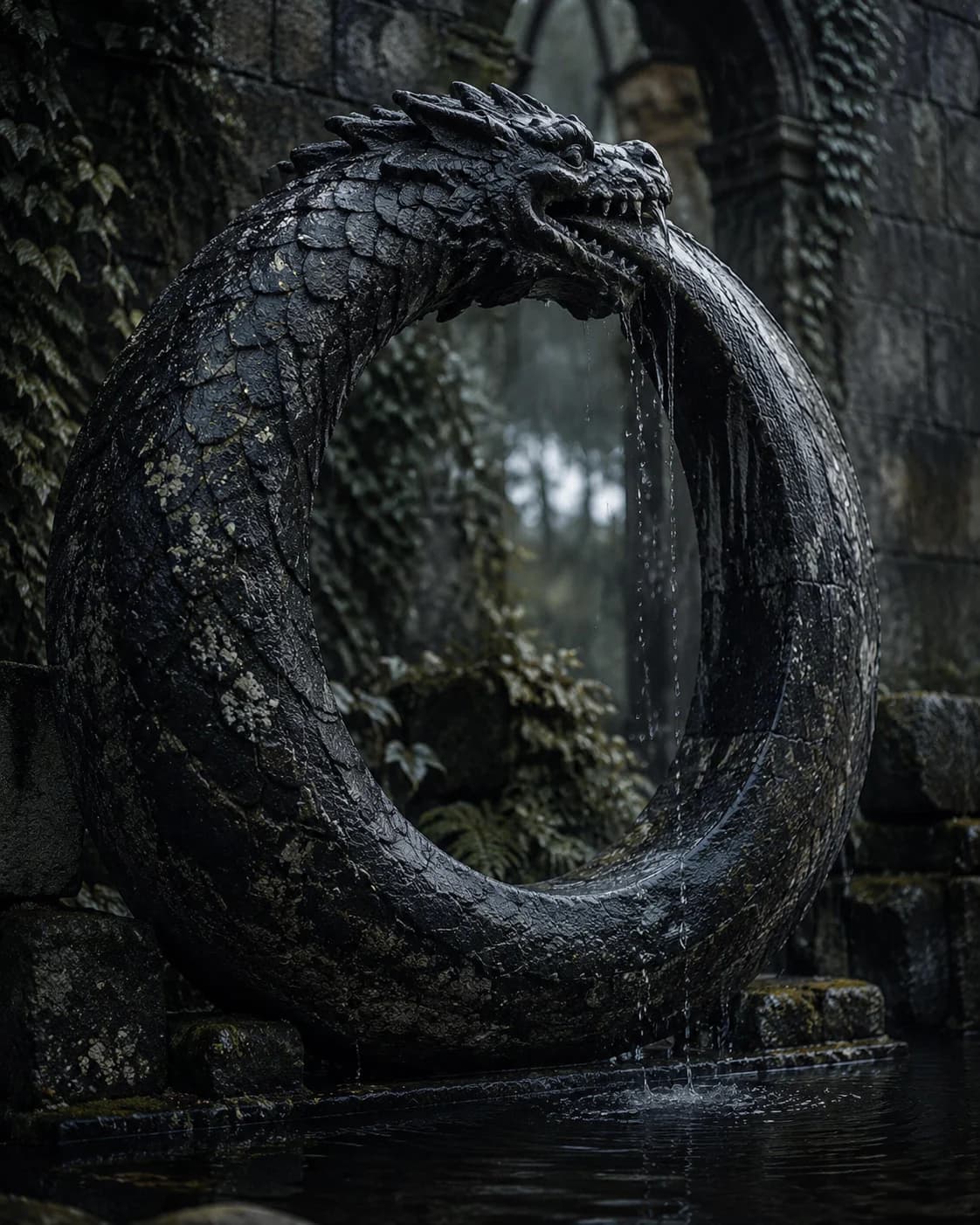
Solve et Coagula
A symbolic and operative tradition concerned with transformation.
ἓν τὸ πᾶν — the All is One. The motto written inside the ouroboros of the Chrysopoeia of Cleopatra (Codex Marcianus graecus 299, a tenth- or eleventh-century copy of a far older figure).
Topic archive
A comparative dossier on metallic, spagyric, spiritual, laboratory, and inner alchemies.
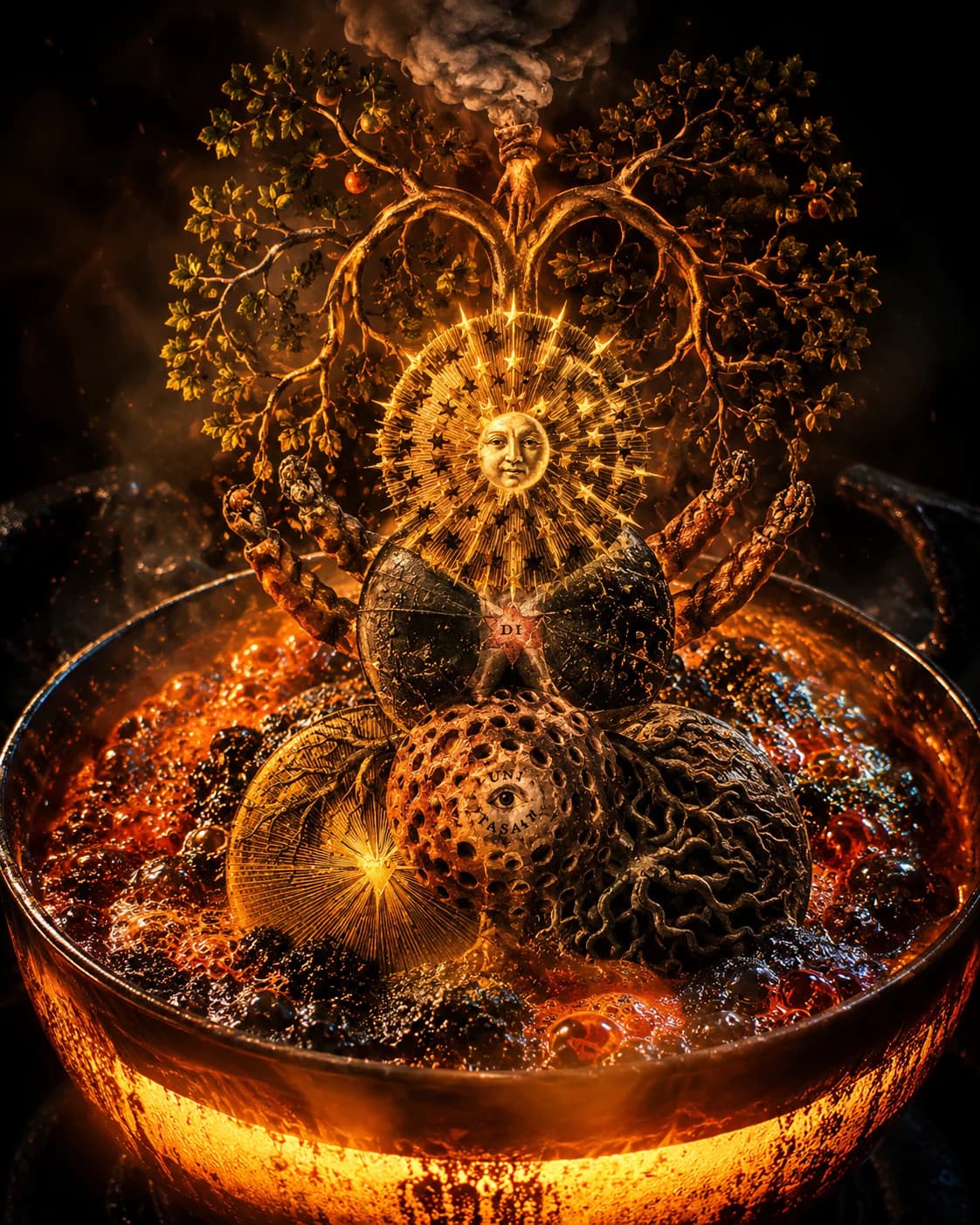
The Great Work
Aetherica treats alchemy as a living language of matter, soul, image, and disciplined inner change.
Alchemy is not one thing. It is a long family of practices and symbolic languages concerned with transformation in matter, medicine, soul, body, cosmos, and divine knowledge.
Some alchemies are explicitly laboratory based; others are medical, cosmological, devotional, initiatic, or contemplative.
This page separates major lineages while showing why they repeatedly converge around purification, death and rebirth, conjunction, tincture, medicine, and the perfected body.
The vessel, the fire, and the tree that rises out of them: matter refined until it carries sun, star, and eye. The operation and the operator are not finally separable.
Magnum Opus
The colour sequence that organises the European work. Most Latin texts run three colours — black, white, red; the four-part scheme here is the older Greek one. The sources describe it as work on matter in a vessel, in language saturated with death, marriage, and rebirth. Reading those colours as stages of the psyche is a later move — Atwood in 1850, Silberer in 1914, Jung in 1944 — productive, but belonging to the reception of alchemy rather than to its texts.
01 · Putrefaction
The Blackening
The matter is reduced, darkened, and allowed to rot. Nothing can be recombined that has not first been undone.
02 · Ablution
The Whitening
What survived the rot is washed. The lunar stage: clarity, separation of the pure from the impure, the first return of light.
03 · Xanthosis
The Yellowing
The yellowing. In the Greek sequence — melanosis, leukosis, xanthosis, iosis — this was a stage in its own right; most Latin texts drop it and run three colours to the red. Kept here because the four-part scheme is older, not because it is more common.
04 · Coagulation
The Reddening
Spirit and body are wedded and fixed. The completed Stone — the point at which the work and the worker are said to coincide.
Metallic doctrine
Beneath the colour sequence sits the theory the colours were about: what bodies are made of, and which bodies the art recognised.
The combustible, active principle: what burns, and what gives a body its form, colour, and desire. Male, hot, dry. In the older two-principle theory it is one of the two exhalations from which all metals are compounded.
The volatile, fusible principle: what flows, vaporises, and carries. Female, cold, moist. Philosophical mercury is expressly not common quicksilver; the texts belabour the point.
The fixed, incombustible principle: the ash that remains after burning, the ground of manifestation. Paracelsus's addition, c. 1520s–30s, to a sulphur-mercury theory that was already seven centuries old when he found it.
Sulphur and mercury are the older pair; salt is Paracelsus’s third. The trio is a theory of composition, not a restatement of the four colours — the sources do not map one onto the other.
Saturn
plumbum
Heaviest and basest of the seven: soft, dull, quickly filmed over by air. The usual starting matter, and the metal tied to putrefaction, melancholy, and the leaden body.
Jupiter
stannum
Soft, white, low-melting; it cries audibly when bent. The expansive, jovial metal; alloyed with copper it makes bronze.
Mars
ferrum
Hard, martial, and alone among the seven in rusting: its red crocus martis makes it the metal of Mars in colour as well as in temper.
Sol
aurum
The fixed and incorruptible body. It does not tarnish and yields to no common solvent but aqua regia. Not a stage of the work but its end.
Venus
cuprum
Warm-coloured, ductile, and green when it weathers; verdigris is its signature. The name runs back to aes cyprium, the metal of Cyprus — Venus's island.
Mercury
argentum vivum
The only metal liquid at ordinary heat, and so the hinge between body and spirit. The sources insist their philosophical mercury is not the apothecary's quicksilver.
Luna
argentum
The second perfect metal: white, ductile, tarnishing but never rusting. Goal of the lesser work, argyropoeia, as gold is of chrysopoeia.
The metal and the planet share one sigil because they were held to be one thing in two states. The glyph is the doctrine, not a mnemonic.
Metals were understood to ripen in the earth — Aristotle’s two exhalations, transmitted through Avicenna — so the art claimed only to hasten what nature was already doing. That premise, not credulity, is what made transmutation intelligible. Metals isolated later (antimony, bismuth, zinc) never joined the seven: the scheme is cosmological, not empirical.
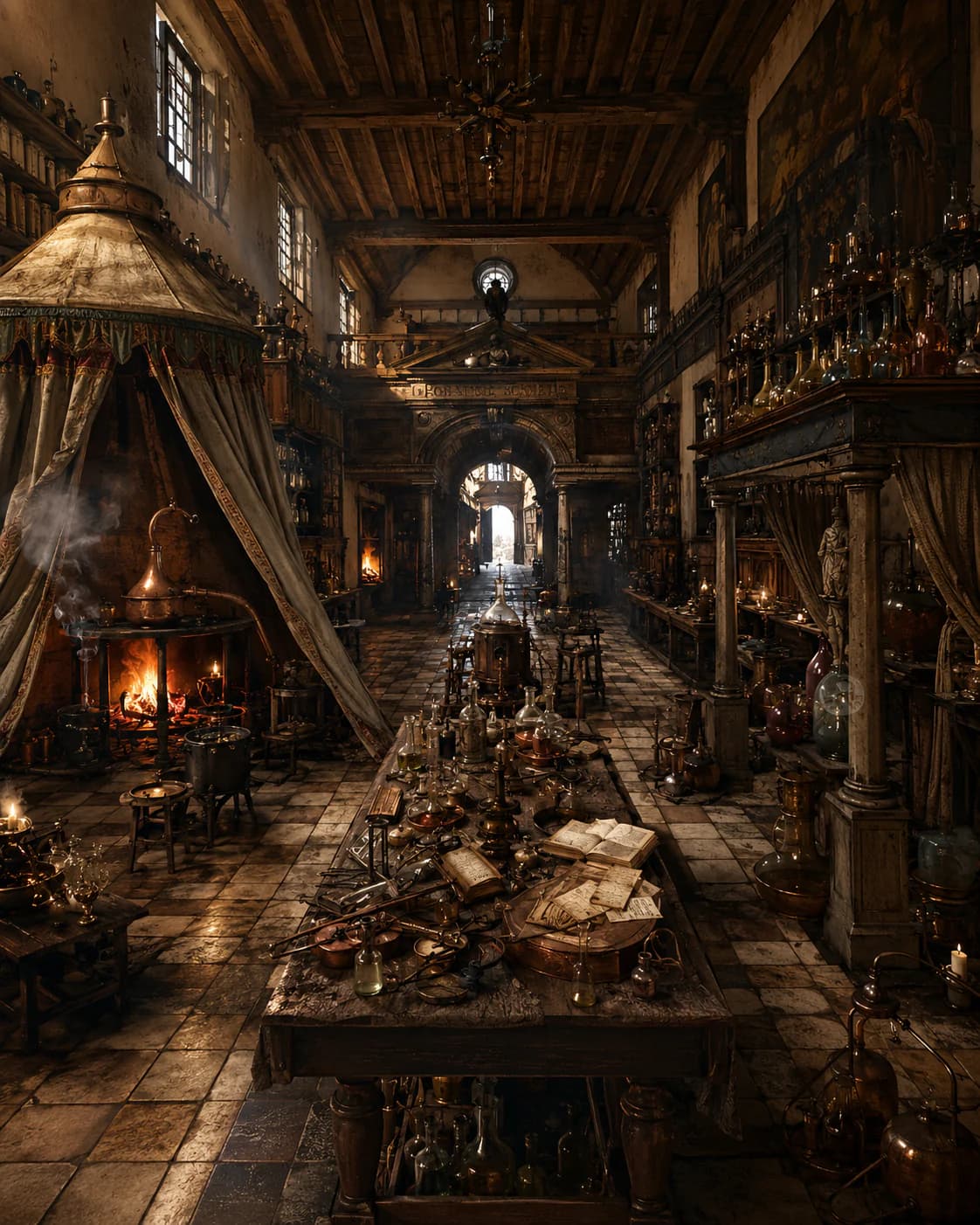
The Operative Art
Furnace, alembic, and notebook — alchemy as bench practice before it was ever a metaphor.
Dossier
Core Operation
Transform the hidden nature of a thing through purification, separation, conjunction, and fixation.
Three Registers
Alchemy moves across matter, medicine, and soul.
Aetherica Use
The topic connects episodes on Daniel Wiseman, metallic alchemy, spagyrics, etheric force, freedom, and symbolic transformation.
Cosmology / Metaphysics
Early alchemical literature develops in Egypt and the Mediterranean, combining craft, metallurgy, dyeing, cosmology, and sacred transformation.
Process Architecture
Representative Texts
A scanning view of the page's major systems, with each tradition kept distinct before deeper archive links, diagrams, and source notes are added.
| System | Period | Architecture | Texts |
|---|---|---|---|
| Hellenistic and Greco-Egyptian alchemy | 1st-4th century | Matter as living process -> Metals as growing bodies -> Dyeing and tincture -> Cosmic sympathy | Zosimos fragments, Physika kai Mystika, Stockholm and Leyden papyri |
| Islamic alchemy | 8th-13th century | Sulfur-mercury theory -> Balance -> Elixir -> Artificial generation | Jabirian corpus, Kitab al-Asrar (al-Razi), Works attributed to al-Razi |
| Latin medieval alchemy | 12th-15th century | Mercury and sulfur -> Stone symbolism -> Generation of metals -> Purification of matter | Turba Philosophorum, Rosarium Philosophorum, Summa perfectionis (pseudo-Geber) |
| Paracelsian and spagyric medicine | 16th-17th century | Sulphur, mercury, salt — the tria prima -> Archeus -> Signatures -> Spagyric separation and recombination | Paracelsian corpus, Archidoxis (c. 1526, printed 1569), Basilica chymica (Croll, 1609) |
| Rosicrucian and spiritual alchemy | 17th century onward | Inner stone -> Christic regeneration -> Mystical death and rebirth -> Invisible college | Fama Fraternitatis, Confessio Fraternitatis, Chymical Wedding |
| Chinese alchemy: waidan and neidan | Early medieval China onward | Waidan and neidan -> Jing, qi, shen -> Cinnabar field -> Return to the Dao | Cantong qi, Baopuzi, Wuzhen pian |
The vocabulary this dossier uses, with the register each definition belongs to. Terms the archive has spoken about link into transcript search; terms treated more fully on this page point there instead.
Operative
Operative maxim
Colour stage
Colour stage
Colour stage
Colour stage
Laboratory / medical
Laboratory / contested
Historiographical
Each period is drawn to its extent on one shared axis, so a three-hundred-year epoch runs three times the length of a hundred-year one. The boundaries are conventional rather than exact: a bar marks where the surviving evidence sits, not the year a tradition began or stopped. The empty stretches are part of the record — but a gap here means this dossier holds nothing in that interval, not that nothing happened in it.
1st-4th century
100 CE – 400 CE
Metallurgy, dyeing, temple symbolism, and Hellenistic cosmology produce early alchemical writing.
100 CE reflects the earliest datable alchemical writing rather than the calendar century; nothing alchemical survives from before it.
Fixed points
Gap · 400 CE – 750 CE · 350 years
Not a void. In the Greek East the tradition continues as commentary — Synesius, the alchemical Olympiodorus, and Stephanos of Alexandria, who lectured on the sacred art at Constantinople under Heraclius. This dossier simply holds no entry for it.
8th-10th century
750 CE – 1000
Islamic alchemy develops laboratory vocabulary, sulfur-mercury theory, balances, elixirs, and medical applications.
The dating of the Jabirian corpus is contested — traditional attribution to a figure of c. 721-815, against Kraus's 1942 redating of the corpus to c. 850-950. This span is wide enough to hold either.
Fixed points
Gap · 1000 – 1140 · 140 years
12th century
1140 – 1200
Arabic alchemical texts enter Europe and begin a new medieval learned tradition.
1144 is conventional, not certain: it rests on the colophon of Robert of Chester's translation, whose date and authorship have both been questioned.
Fixed points
Gap · 1200 – 1300 · 100 years
14th-15th century
1300 – 1500
European alchemy develops elaborate emblematic and allegorical language around the Philosophers' Stone.
Fixed points
16th century
1520 – 1620
Alchemy becomes medical, astral, and spagyric through Paracelsus and his followers.
Deliberately a century, not a lifetime. Paracelsus (1493-1541) published almost nothing while alive; Paracelsianism is a posthumous editorial movement peaking c. 1570-1620 — which is why it overlaps the entry below.
Fixed points
17th century
1600 – 1700
Alchemical language is put to work on initiation and Christian regeneration — and, by the same people, at the bench. The word of the period is chymistry and it does not distinguish alchemy from chemistry: Starkey, writing as Eirenaeus Philalethes, is the most read alchemical author of the age and Boyle’s correspondent, and Newton leaves over a million words of alchemical manuscript.
Fixed points
Gap · 1700 – 1850 · 150 years
19th-20th century
1850 – 1980
Alchemy is reread through Hermetic orders, Theosophy, depth psychology, and modern esoteric practice.
1850 is a genuine hinge: the claim that alchemy was never really about matter is first stated in print by Atwood and Hitchcock within seven years of each other. Critical philology begins inside this same window and against its grain.
Fixed points
Contemporary
1980 – present
Modern practitioners revisit metallic, mineral, plant, and inner alchemies through research, practice, and critical scholarship.
An open period. The terminus is a container edge, not an event.
Fixed points
fl. c. 300
One of the earliest major alchemical authors, blending craft procedure with visionary symbolism. Our only real source for several earlier practitioners.
1st-3rd century
Known only through Zosimos, who cites her as a technical authority. The tribikos and kerotakis are described as hers, and the water bath still carries her name — balneum Mariae, bain-marie.
283-343
The Baopuzi neipian, c. 317-320, is the fullest early account of Chinese external alchemy: elixirs, ingredients, and the transcendents who took them.
8th-10th century
A vast Arabic corpus by many hands, influential for theories of balance, elixir, and metallic transformation. Not the author of the Latin Summa perfectionis.
c. 854-925
Physician and alchemist, Latin Rhazes. His Kitab al-Asrar classifies substances, apparatus, and procedures with the allegory largely stripped out — the closest thing the tradition has to a laboratory manual. Not Fakhr al-Din al-Razi.
d. 1082
The Wuzhen pian, 1075, founds the southern neidan lineage and is the point at which internal alchemy becomes a systematic discourse rather than a reading of older elixir texts.
1493/94-1541
Recast alchemy as medicine: the tria prima, the archeus, the doctrine of signatures, preparation over Galenic prescription. His influence is largely posthumous, through printings from the 1560s to the Huser edition of 1589-91.
1568-1622
Physician to Rudolf II and the most inventive of the Rosicrucian-era emblematists. Atalanta fugiens (Oppenheim, 1617) sets fifty emblems against fifty fugues for three voices.
1621-1666
Wrote as Eugenius Philalethes: a Welsh writer on spirit, nature, and the first matter, and the English translator of the Rosicrucian manifestos in 1652. Routinely confused with Eirenaeus Philalethes, who was George Starkey.
1628-1665
Harvard-trained, wrote as Eirenaeus Philalethes, and was the most widely read alchemical author of the later seventeenth century. Boyle's correspondent and Newton's source.
1817-1910
A Suggestive Inquiry into the Hermetic Mystery (1850) is the founding text of the reading that alchemy was never really about matter. Her father bought back and burned the edition; the argument survived him.
1898-1974
Italian Traditionalist. La tradizione ermetica (1931) reads alchemy as an initiatic path and a doctrine of inner sovereignty rather than a laboratory art.
Greco-Egyptian, 1st-2nd c.
The earliest substantial alchemical text, written under the name of Democritus by an author known only as pseudo-Democritus. Recipes for dyeing, gilding, and the imitation of gold and silver, framed as revealed secrets.
Greco-Egyptian, 3rd-4th c.
Two Greek recipe collections from Thebes. No theory and no allegory: craft procedures for dyeing, gilding, and imitating gems and precious metals. The bench floor under everything else on this list.
Greco-Egyptian
Visionary and technical fragments, surviving largely through Syriac and Arabic transmission rather than continuous Greek copying.
Arabic, by the 9th c.; Latin from the 12th
The Emerald Tablet. Not by Hermes Trismegistus and with no recovered Greek original: its earliest known text sits inside the Arabic Sirr al-khaliqa ascribed to Balinas. Fourteen lines that European alchemy read as its whole programme. It does not contain the phrase solve et coagula.
Latin, 12th c., from a lost Arabic original
A staged dialogue of pseudo-Presocratic philosophers, and the hinge on which Arabic alchemical vocabulary entered Latin Europe.
Latin, later 13th c.
Circulates under the name Geber and is not by Jabir ibn Hayyan; there is no Arabic original. Newman's 1991 critical edition argues for Paul of Taranto. The most rigorous corpuscular theory of matter the tradition produced.
Latin, 15th c.; woodcuts printed 1550
The compilation is fifteenth-century; the twenty woodcuts that made it famous — coniunctio, death, the returning soul — belong to the illustrated Frankfurt printing of 1550. Jung's 1946 commentary is on that image series, not on the medieval text.
Latin, 15th c.
Circulates under the name of Thomas Aquinas; the ascription is spurious. A commentary that reads the Song of Songs and the Sapiential books as alchemy, leaning on the Latin Senior. Von Franz's edition defends the Aquinas attribution; that defence has not been accepted.
Rosicrucian, 1616
Published anonymously at Strasbourg. Johann Valentin Andreae later described it as a ludibrium — a piece of play. Read as initiatic allegory ever since, which may be the joke's most durable result.
Chinese alchemy
Ascribed to Wei Boyang and traditionally dated 142 CE; the received text is layered and the ascription legendary. Waidan and neidan commentators read the same lines as external elixir and as internal refinement, and both readings have long lineages.
Medical alchemy
A broad and unstable body of genuine, disputed, and outright spurious works, printed and reprinted from the 1560s. The pseudo-Paracelsian layer is large and was commercially useful.
This dossier is an Aetherica editorial research layer. It is designed to support deeper pages, archive search, future bibliographies, and interactive diagrams. Historical claims, symbolic readings, and modern esoteric interpretations should remain clearly labeled as the library expands.
Continue