Core Motif
The human as a mortal-immortal double, capable of knowing the mind that made the cosmos.
Nous and LogosAs above, so belowRebirth in Corpus Hermeticum XIIIAscent through the spheres
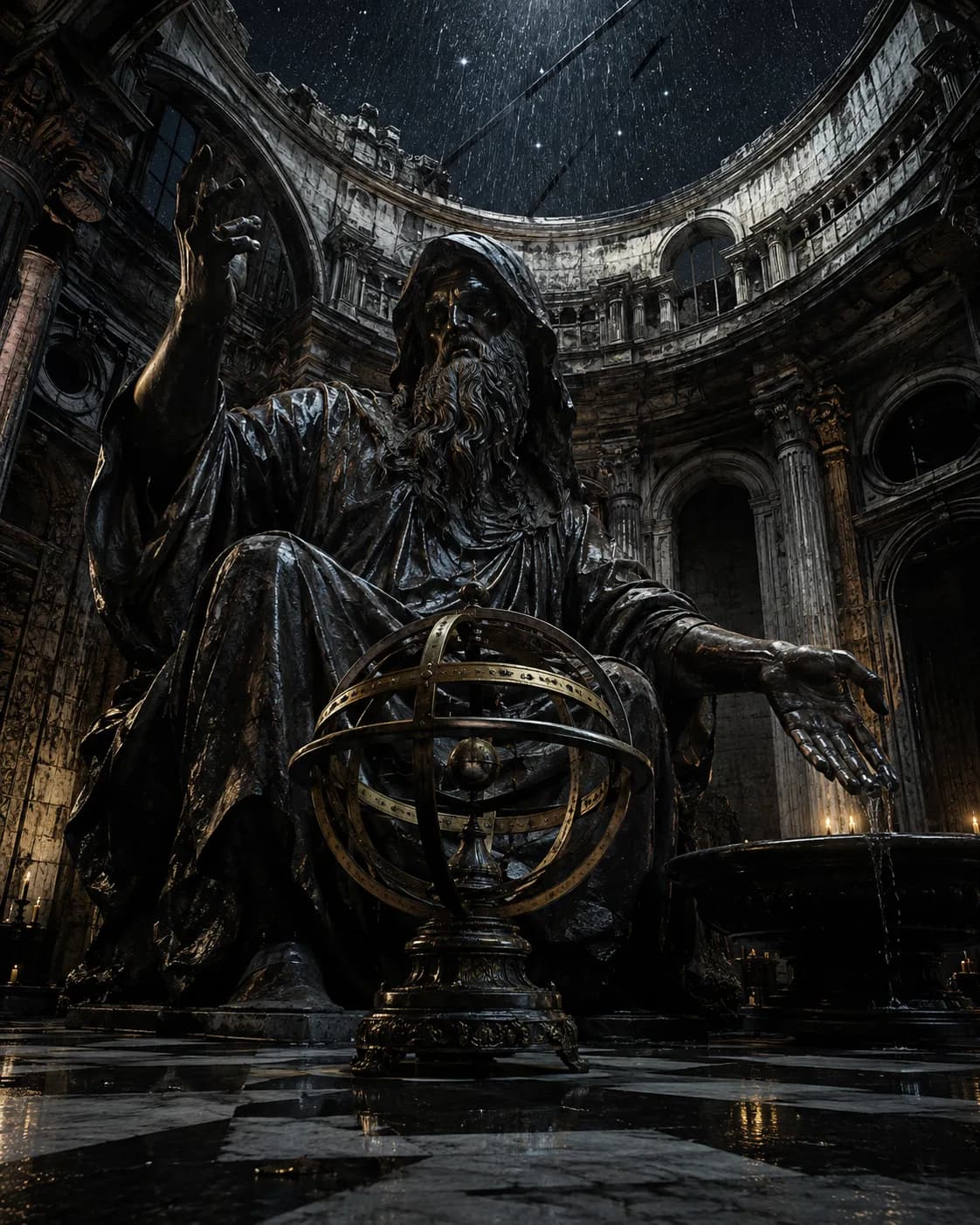
Trismegistus
A family of texts and practices associated with Hermes Trismegistus.
The Hermetic writings are not one book but a library assembled across centuries, attributed to a teacher who may never have lived. What they share is a conviction that the cosmos is intelligible, and that the mind reading it is of the same order as the thing read.
Topic archive
A dossier on the Hermetica, their Greco-Egyptian world, and the long afterlife of Hermes Trismegistus.
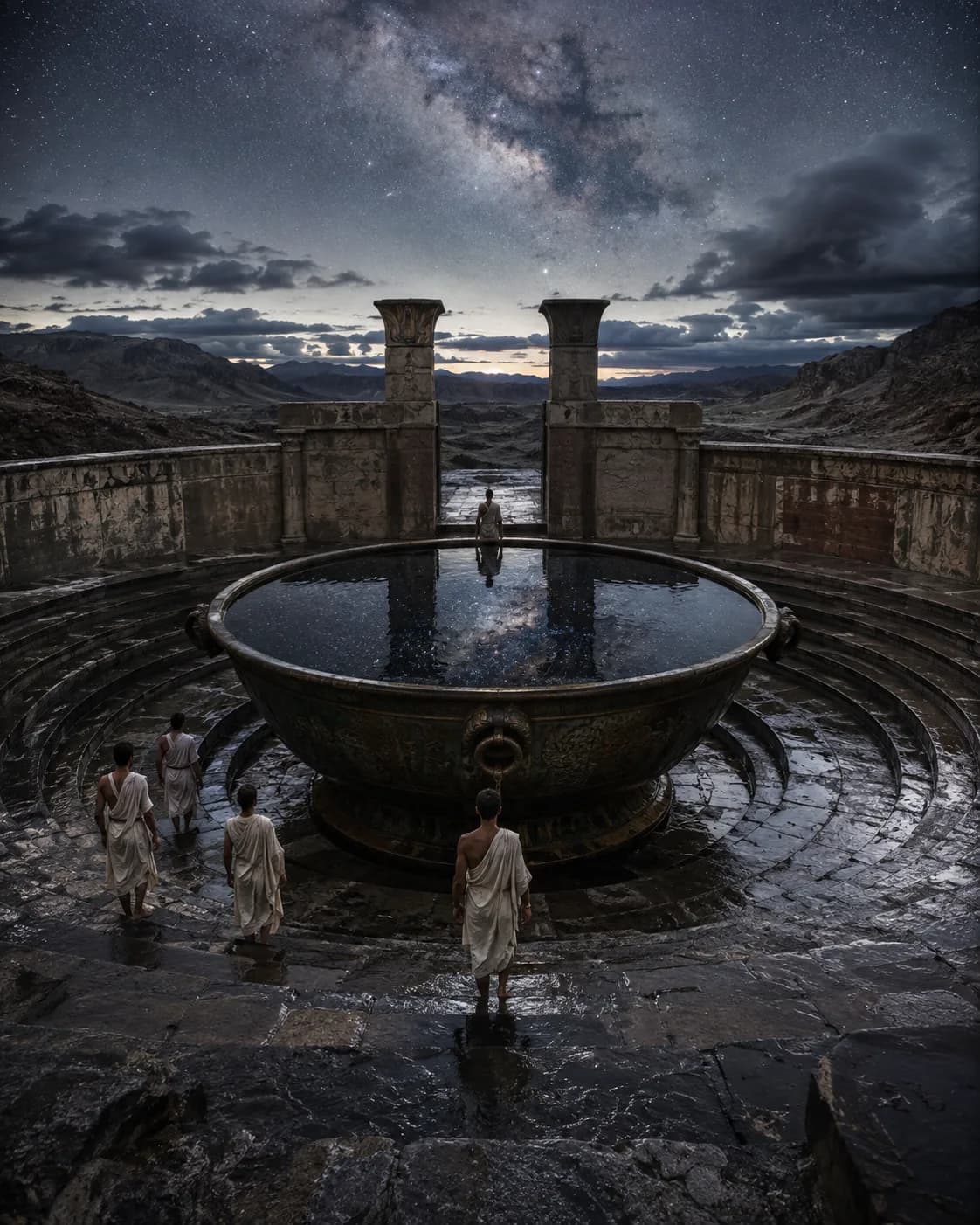
The Krater
The archive follows Hermetic ideas through philosophy, magic, Christianity, and Renaissance revival.
Hermeticism names the traditions descending from Greek writings attributed to Hermes Trismegistus — the thrice-greatest — composed mainly in Roman Egypt between the first and third centuries CE, where the scribe-god Thoth had long been read as Hermes.
The corpus divides in two: philosophical Hermetica on God, cosmos, mind, and rebirth, and the older technical Hermetica of astrology, medicine, alchemy, and talismans. The two families share an author and a cosmos of sympathies, not a single doctrine.
This page keeps the ancient corpus, the Arabic transmission, the Renaissance revival, and the modern receptions distinct, because most confusions about 'Hermeticism' come from silently blending them into one continuous institution.
Corpus Hermeticum IV: God filled a great basin with Nous, sent it down, and had a herald cry to the hearts of men — immerse yourself, if you can. Baptism not in water but in mind, offered to all and taken by few.
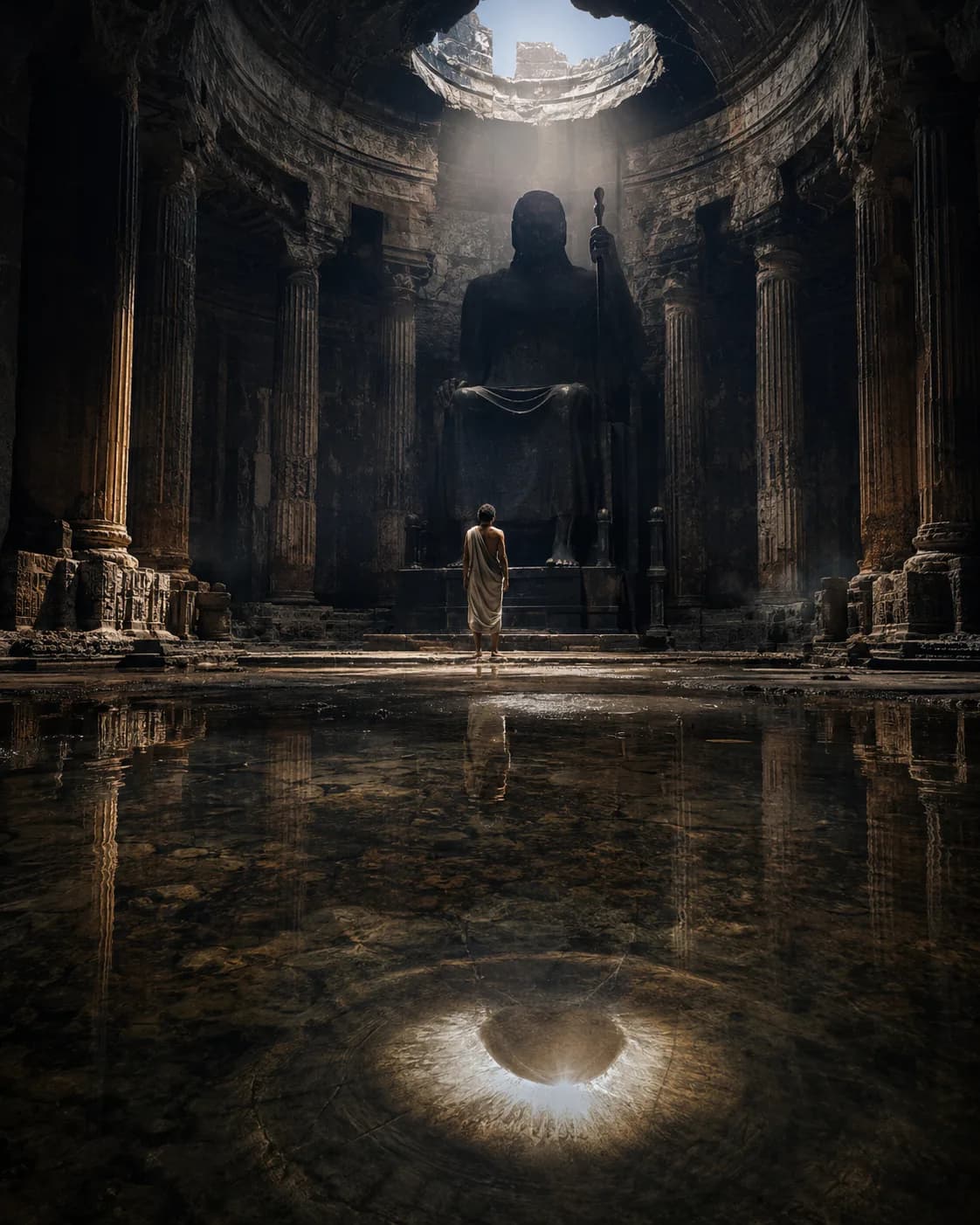
The Making of Gods
The Asclepius' most dangerous sentence: as the Father makes the heavenly gods, so man makes the gods of the temples — statues ensouled, conscious, foreknowing. Augustine spent a book of the City of God refusing it, which is one measure of how seriously it was taken.
Dossier
Core Motif
The human as a mortal-immortal double, capable of knowing the mind that made the cosmos.
Two Corpora
Philosophical treatises of instruction beside technical manuals of astrology, alchemy, and talismans.
Aetherica Use
The topic gathers episodes on Hermetic philosophy, correspondences, Renaissance magic, and the corpus' modern receptions.
Cosmology / Metaphysics
Greek treatises framed as the teaching of Hermes to Tat, Asclepius, and Ammon: revelation, cosmology, and the regeneration of the soul.
Cosmological Architecture
Representative Texts
A scanning view of the page's major systems, with each tradition kept distinct before deeper archive links, diagrams, and source notes are added.
| System | Period | Architecture | Texts |
|---|---|---|---|
| Philosophical Hermetica | 1st-3rd century CE | The One, the Good -> Nous as divine mind -> Logos ordering the cosmos -> The human as mortal-immortal double | Corpus Hermeticum I (Poimandres), Corpus Hermeticum XIII, Asclepius |
| Technical Hermetica | 3rd century BCE-3rd century CE | Cosmic sympathy -> Decans and melothesia -> Chains of stone, plant, and star -> Craft as participation in the cosmos | Liber Hermetis, Cyranides, Astrological Hermetica |
| Arabic and medieval Hermes | 8th-13th century | Hermes as prophet of the sciences -> The three Hermeses of Abu Ma'shar -> Talismanic astral magic -> The Tablet's above-and-below | Kitab Sirr al-khaliqa (Emerald Tablet), Picatrix (Ghayat al-Hakim), Liber XXIV philosophorum |
| Renaissance revival | 1463-1614 | Prisca theologia -> Man the great miracle -> Natural magic and correspondence -> Egyptian antiquity claimed, then lost | Ficino, Pimander (1471), Lazzarelli, Crater Hermetis, Casaubon, De rebus sacris (1614) |
| Modern receptions | 1888-present | Golden Dawn synthesis -> The Kybalion's modern principles -> Nag Hammadi Hermetica -> The corpus re-read as Greco-Egyptian | The Kybalion (1908), Nag Hammadi codex VI, Nock-Festugiere edition |
The vocabulary this dossier uses, with the register each definition belongs to. Terms the archive has spoken about link into transcript search; terms treated more fully on this page point there instead.
Greek
Greek
Latin
Each period is drawn to its extent on one shared axis, so a three-hundred-year epoch runs three times the length of a hundred-year one. The boundaries are conventional rather than exact: a bar marks where the surviving evidence sits, not the year a tradition began or stopped. The empty stretches are part of the record — but a gap here means this dossier holds nothing in that interval, not that nothing happened in it.
Ptolemaic Egypt
250 BCE – 30 BCE
In Greek-speaking Egypt the scribe-god Thoth is assimilated to Hermes, and astrological and technical writings begin to circulate under the name of the thrice-greatest.
Fixed points
Gap · 30 BCE – 50 CE · 80 years
1st-3rd century CE
50 CE – 300 CE
The treatises later gathered as the Corpus Hermeticum, together with the Perfect Discourse and the Stobaeus excerpts, are composed in Roman Egypt: dialogues of Hermes, Tat, and Asclepius on mind, cosmos, and rebirth.
Fixed points
Late antiquity
300 CE – 430 CE
Lactantius enlists Hermes as a pagan witness to Christian truth; Augustine condemns the Asclepius' animation of statues; three Hermetic texts are copied into the Nag Hammadi codices and buried.
Fixed points
Gap · 430 CE – 750 CE · 320 years
Transmission rather than extinction: the Latin Asclepius keeps circulating and Greek copies survive in Byzantium. The dossier simply holds no dated landmark in the interval.
Abbasid Baghdad
750 CE – 1000
Arabic writers identify Hermes with Idris and Enoch; the Emerald Tablet surfaces inside the Book of the Secret of Creation; Hermetic astrology and alchemy pass into Arabic science.
Fixed points
Gap · 1000 – 1120 · 120 years
12th-13th century
1120 – 1300
Translation from Arabic brings the Emerald Tablet and astral magic west; the Asclepius is quoted in the schools; the Book of the Twenty-Four Philosophers coins its God-as-infinite-sphere formula under Hermes' name.
Fixed points
Gap · 1300 – 1463 · 163 years
1463-1614
1463 – 1614
Cosimo de' Medici has Ficino translate the Corpus before Plato; printed in 1471, the Pimander runs through edition after edition, and Hermes is read as the most ancient theologian.
Fixed points
1614
1614
Isaac Casaubon shows on philological grounds that the Greek of the Corpus is post-Christian. Hermes' claim to primeval antiquity collapses in learned Europe — without ending Hermetic practice in alchemical and Rosicrucian circles.
The technical Hermetica were untouched by the argument, and the redating took the better part of a century to become consensus.
17th-19th century
1614 – 1888
The word 'Hermetic' migrates toward alchemy and secrecy; Rosicrucian manifestos, Hermetic compendia, and Masonic legend keep the figure at work beneath official learning.
Fixed points
1888-1908
1888 – 1908
The Hermetic Order of the Golden Dawn fuses Hermetica, Kabbalah, and ceremonial magic into one curriculum; The Kybalion popularizes seven 'Hermetic' principles that are modern New Thought rather than the ancient corpus.
20th century-present
1924 – present
Critical editions and the Nag Hammadi finds re-situate the Hermetica in Roman Egypt, read as Greco-Egyptian teaching rather than either primeval revelation or mere forgery.
Fixed points
legendary
The attributed teacher: a fusion of Thoth and Hermes functioning as an author-name for a whole literature, not a recoverable person.
1433-1499
Translator whose Pimander put the Corpus at the head of Renaissance philosophy and made Hermes the most ancient theologian.
1447-1500
Poet and Hermetist who translated the remaining treatises and wrote the Crater Hermetis, the revival's most devotional text.
1559-1614
Philologist whose dating of the Corpus ended its claim to primeval antiquity and redrew the tradition's history.
1863-1933
Theosophical scholar whose Thrice-Greatest Hermes carried the corpus into the occult revival's hands.
1898-1982
Co-editor of the critical edition and author of the mid-century synthesis that framed all later scholarship.
1899-1981
Historian whose Giordano Bruno and the Hermetic Tradition defined — and by later judgment overstated — the Hermetic thread in Renaissance thought.
Philosophical Hermetica
Seventeen Greek treatises of revelation and instruction, from the vision of Poimandres to the rebirth of treatise XIII.
Philosophical Hermetica
The Perfect Discourse, surviving whole only in Latin; source of the god-making passage Augustine attacked.
Anthology
Hermetic fragments preserved in a fifth-century anthology, including the Virgin of the World.
Arabic transmission
A short cosmological oracle first attested in Arabic — 'as above, so below' in its most quoted form.
Technical Hermetica
The talismanic compendium through which Hermetic astral magic reached Latin Europe.
Modern reception
A 1908 New Thought work, widely influential; its seven principles are modern, not ancient.
This dossier is an Aetherica editorial research layer. It is designed to support deeper pages, archive search, future bibliographies, and interactive diagrams. Historical claims, symbolic readings, and modern esoteric interpretations should remain clearly labeled as the library expands.
Continue