Core Motif
Kabbalah's central gesture is to read the Godhead as a structured emanation and human action as consequential within it — the commandments, performed with intention, reach upward and repair.

Ma'aseh Merkavah
Jewish mystical tradition and its later Christian and esoteric receptions.
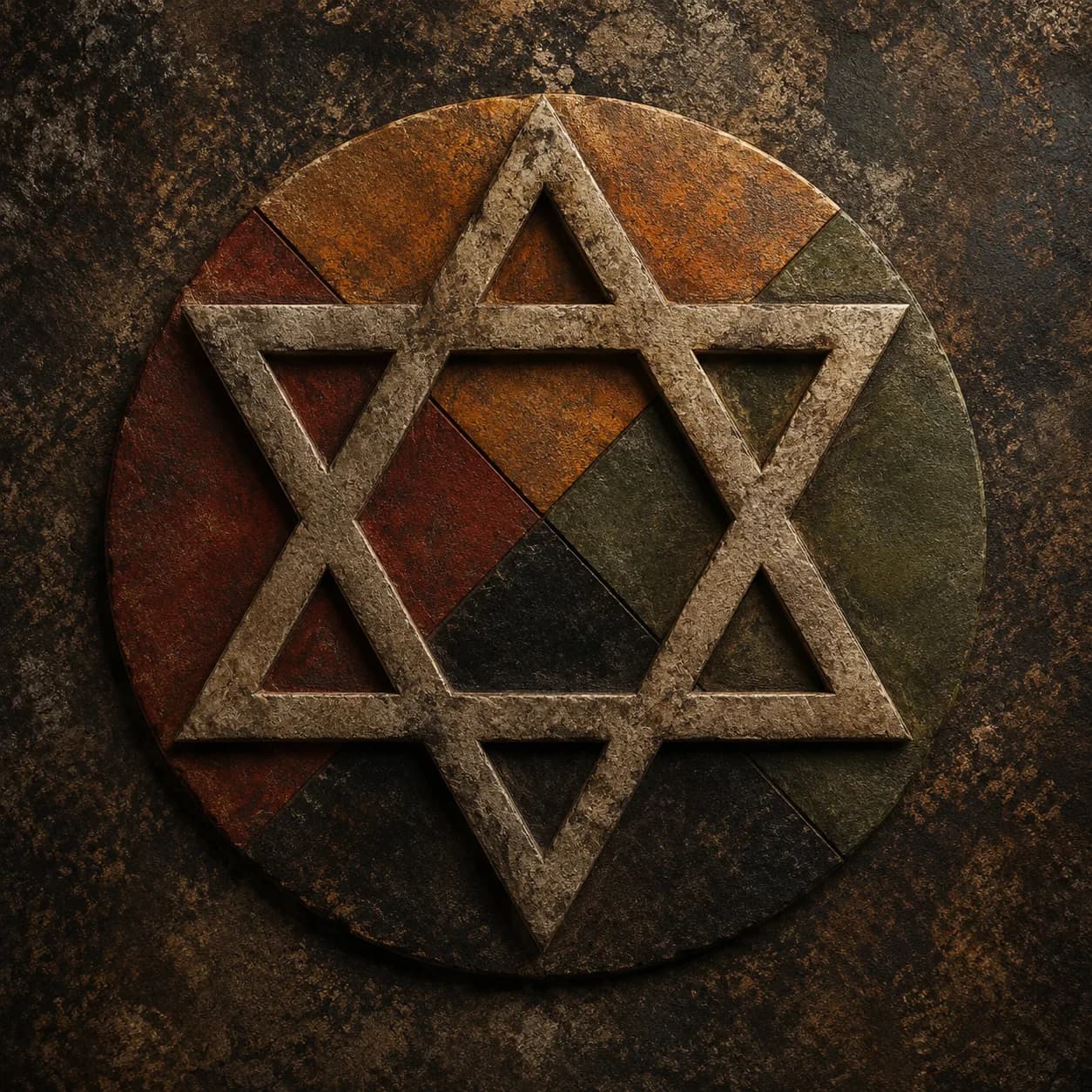
Two triangles interlocked: what is above answered by what is below, and neither legible without the other. The figure is older and wider than any single tradition that has claimed it.
Topic archive
A dossier on the Kabbalah in its three families — Jewish, Christian, and Hermetic — and on the discipline of not mistaking one for another.

The Ten Utterances
Pages distinguish tradition, reception, and modern interpretation with care.
Kabbalah is the mystical and theosophical tradition of Judaism, elaborated from late antique ascent literature into the sefirotic systems of medieval Provence and Castile, and reorganised in sixteenth-century Safed around contraction, rupture, and repair.
This dossier keeps three families deliberately distinct — Jewish Kabbalah, Christian Cabala, and Hermetic Qabalah — because their conflation is the commonest and most consequential error in the field.
Datings are given as the evidence allows: the Sefer Yetzirah is contested across four centuries, the Zohar is pseudepigraphic and says so here, and the Golden Dawn's Qabalah is stated plainly to be a nineteenth-century synthesis.
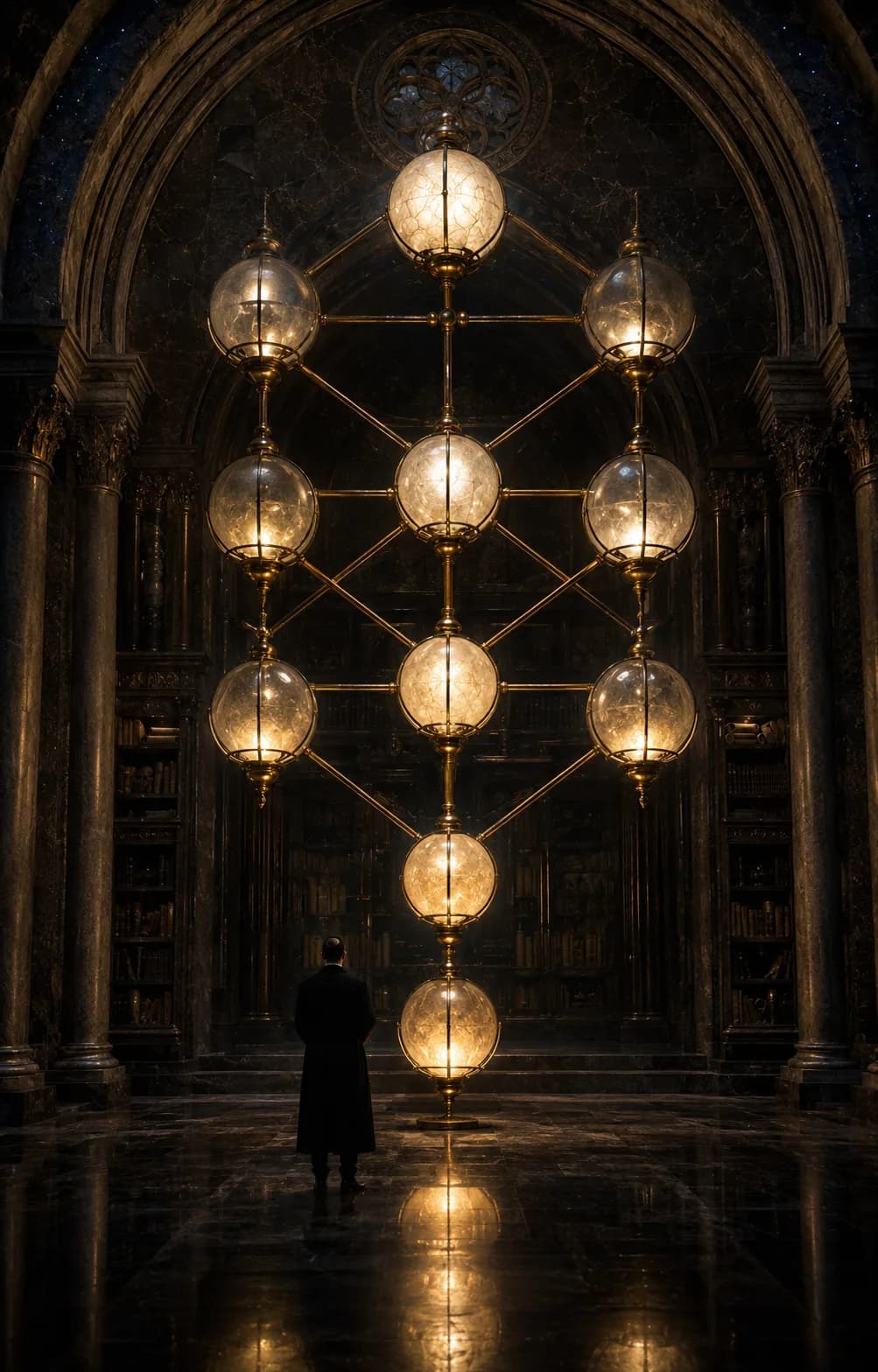
Ten lamps and the paths between them. The diagram is late — the sephirotic tree as drawn is a medieval and early modern development — but what it organises is much older: the problem of how an unbounded source becomes a world without ceasing to be unbounded.
Dossier
Core Motif
Kabbalah's central gesture is to read the Godhead as a structured emanation and human action as consequential within it — the commandments, performed with intention, reach upward and repair.
Three Kabbalahs
Three families share a vocabulary and a diagram while diverging in theology, community, and aim; keeping them distinct is the first act of precision in this field.
Aetherica Use
How the archive puts this dossier to work — indexing, retrieval, and comparison across episodes that touch any of the three families.
Cosmology / Metaphysics
The ascent literature of late antique Judaism: practitioners styled descenders to the Chariot traverse seven heavenly palaces, past angelic guards, by means of seals, divine names, and hymns, toward the vision of the enthroned Glory. Redacted over centuries and socially elusive, it is the deep background from which later Kabbalah drew images and prestige — while remaining a distinct enterprise of vision rather than emanation.
Sefirotic Architecture
Representative Texts
A scanning view of the page's major systems, with each tradition kept distinct before deeper archive links, diagrams, and source notes are added.
| System | Period | Architecture | Texts |
|---|---|---|---|
| Merkavah and Heikhalot | c. 2nd-7th centuries CE | Seven palaces (heikhalot) of graded ascent -> The Chariot (Merkavah) as the object of vision -> Angelic gatekeepers, seals, and divine names -> Hymnic technique as vehicle of ascent | Heikhalot Rabbati, Heikhalot Zutarti, 3 Enoch (Sefer Heikhalot) |
| Zoharic and theosophical Kabbalah | Provence, Gerona, Castile, c. 1150-1300 | Ein Sof beyond all attribute -> Ten sefirot as structured emanation -> Shekhinah as exiled presence -> Torah as cosmic symbol read in four senses | Sefer ha-Bahir, Zohar, Azriel of Gerona, Commentary on the Ten Sefirot |
| Lurianic Kabbalah | Safed, 16th century | Tzimtzum — divine self-contraction -> Shevirat ha-kelim — the breaking of the vessels -> Tikkun — cosmic repair through commandment and intention -> Partzufim — the reconfigured divine countenances | Etz Hayyim (Hayyim Vital), Sha'ar ha-Gilgulim, Cordovero, Pardes Rimmonim (the Safed background) |
| Christian Cabala | Italy and Germany, 1486 to the 17th century | Kabbalah as confirmation of Christian doctrine -> The Pentagrammaton — the Name amplified toward Jesus -> Hebrew as the language of creation -> Prisca theologia — one ancient wisdom behind all traditions | Pico, Conclusiones (900 Theses), Reuchlin, De verbo mirifico, Reuchlin, De arte cabalistica |
| Hermetic Qabalah | Golden Dawn line, 1888 onward | The Tree of Life as universal scheme of correspondences -> Tarot, planets, and elements keyed to paths and sefirot -> Pathworking — imaginal ascent through the Tree -> The Four Worlds as planes of magical operation | Mathers, The Kabbalah Unveiled, Fortune, The Mystical Qabalah, Crowley, 777 |
The vocabulary this dossier uses, with the register each definition belongs to. Terms the archive has spoken about link into transcript search; terms treated more fully on this page point there instead.
Hebrew
Hebrew
Hebrew
Hebrew
Hebrew
Hebrew
Hebrew
Hebrew
Each period is drawn to its extent on one shared axis, so a three-hundred-year epoch runs three times the length of a hundred-year one. The boundaries are conventional rather than exact: a bar marks where the surviving evidence sits, not the year a tradition began or stopped. The empty stretches are part of the record — but a gap here means this dossier holds nothing in that interval, not that nothing happened in it.
c. 200-700 CE
200 CE – 700 CE
The ascent literature of late antiquity: descenders to the Chariot pass through seven palaces guarded by angelic gatekeepers, armed with seals and hymns. The corpus was redacted over centuries and its social setting is still argued; it is the deep background of Kabbalah, not yet Kabbalah itself.
The visionary tradition looks back to Ezekiel's chariot and to tannaitic restrictions on expounding it.
Fixed points
3rd-7th c. (contested)
250 CE – 650 CE
A brief, gnomic treatise describes creation through thirty-two paths of wisdom — ten sefirot and the twenty-two letters. Its date is contested across the whole span from the third century to the seventh, and its sefirot are numbers and limits, not yet the divine potencies of the later Kabbalah.
Every later family — Jewish, Christian, and Hermetic — reads itself back into this book; the book itself resists all of them.
Gap · 700 CE – 1176 · 476 years
The centuries between the Heikhalot corpus and the Bahir are transmission rather than void — ascent texts copied in the geonic academies, Yetzirah commentaries, and channels into the Rhineland pietists that scholarship is still tracing.
c. 1176
1176
The Sefer ha-Bahir appears in Provence around 1176, the first text to speak of the sefirot as living divine potencies arranged in a structure. It presents itself as ancient midrash; its actual prehistory is obscure, and the question of older oral or written sources remains open.
Fixed points
Gap · 1176 – 1280 · 104 years
1280s
1280 – 1290
The Zohar begins to circulate in Castile in the 1280s, in the circle of Moses de Leon, written in an artificial Aramaic as the ancient midrash of Shimon bar Yochai. The pseudepigraphy was suspected almost at once and is now established; the book's power was never diminished by it.
Between Bahir and Zohar stand Gerona and Nahmanides' guarded allusions — and, in the same decade as the Zohar, Abulafia's quite different ecstatic school.
Fixed points
Gap · 1290 – 1486 · 196 years
The gap before this entry is an artefact of the chart, not of history: Jewish Kabbalah continued without interruption through the fourteenth and fifteenth centuries, in Spain, Italy, and the East.
1486-1517
1486 – 1517
Pico della Mirandola's 900 Theses of 1486 announce that no science gives greater certainty of the divinity of Christ than magic and Kabbalah; Reuchlin's De arte cabalistica of 1517 builds the system. A second family is founded — Christian in aim, Latin in language, and from the outset distinct from the Judaism it borrowed from.
Fixed points
1492
1492
The expulsion of the Jews from Spain in 1492 scatters the Castilian kabbalistic inheritance across the Mediterranean — to Italy, North Africa, and the Ottoman lands. Within two generations the tradition's centre of gravity has moved to the Galilean town of Safed.
Fixed points
Gap · 1517 – 1570 · 53 years
1570-1572
1570 – 1572
Isaac Luria teaches at Safed for barely two years before his death in 1572, leaving almost nothing in writing. Through Hayyim Vital's redactions his system — tzimtzum, the breaking of the vessels, tikkun — becomes the dominant kabbalistic theology of early modern Judaism.
Fixed points
Gap · 1572 – 1665 · 93 years
1665-1666
1665 – 1666
Nathan of Gaza proclaims Sabbatai Zevi messiah in 1665, reading his mission through Lurianic categories of sparks and repair; the movement sweeps the diaspora until Sabbatai's conversion to Islam under Ottoman pressure in 1666. The apostasy discredits public messianic Kabbalah and drives its radical wing underground.
Fixed points
Gap · 1666 – 1740 · 74 years
c. 1740-1760
1740 – 1760
From around 1740 the Baal Shem Tov, who dies in 1760, and his circle turn Lurianic and earlier kabbalistic materials toward a popular devotional revival in Podolia and Volhynia — devekut for the ordinary Jew, the rebbe as channel, Kabbalah internalised as psychology of worship.
Fixed points
Gap · 1760 – 1888 · 128 years
1888
1888
The Hermetic Order of the Golden Dawn is founded in London in 1888, and with it Hermetic Qabalah takes settled form: the Tree of Life as a scheme of correspondences binding tarot, astrology, and ceremonial magic. It is a nineteenth-century synthesis built from Latin intermediaries, and should be named as such.
Fixed points
Gap · 1888 – 1941 · 53 years
1941-
1941 – present
Gershom Scholem's Major Trends in Jewish Mysticism of 1941 founds the modern academic study of Kabbalah; Idel, Liebes, and their successors have since revised his map without abandoning the enterprise. The three families are now studied, and distinguished, as history.
Fixed points
2nd century CE
Tannaitic sage in whose name the Zohar was written a millennium after his death — the tradition's chosen ancient mouthpiece, not its author.
c. 1240-1305
Castilian kabbalist in whose circle the Zohar was composed and circulated as ancient midrash; the pseudepigraphy was questioned immediately after his death.
1534-1572
The Ari of Safed, whose two years of oral teaching reorganised Kabbalah around contraction, rupture, and repair.
1542-1620
Luria's principal disciple and recorder; nearly everything called Lurianic reaches us through his redactions.
1463-1494
Florentine philosopher whose 900 Theses of 1486 announced that Kabbalah confirmed Christianity — the founding gesture of Christian Cabala.
1455-1522
German Hebraist whose De arte cabalistica of 1517 gave Christian Cabala its systematic form and defended Jewish books against confiscation.
1854-1918
Golden Dawn co-founder whose translation of Rosenroth wired kabbalistic diagrams into a new occult synthesis — Hermetic Qabalah, a creation of his own century.
1897-1982
Founder of the academic study of Jewish mysticism; Major Trends of 1941 gave the field its map and its arguments.
Proto-kabbalistic (Jewish)
A terse cosmological treatise on creation through thirty-two paths — ten sefirot and twenty-two letters. Composed somewhere between the third and seventh centuries; the dating remains genuinely contested.
Jewish Kabbalah
The earliest text to treat the sefirot as divine potencies, surfacing in Provence around 1176 with no secure earlier history; presented as ancient midrash.
Jewish Kabbalah
The tradition's central book, circulated in Castile in the 1280s within the circle of Moses de Leon and written in artificial Aramaic as the ancient midrash of Shimon bar Yochai.
Lurianic Kabbalah
Hayyim Vital's great redaction of Luria's oral teaching — tzimtzum, the breaking of the vessels, and tikkun in systematic form; Luria himself wrote almost nothing.
Christian Cabala
Reuchlin's dialogue of 1517, the systematic statement of Christian Cabala — kabbalistic method turned to Christian apologetic ends by a scholar who nonetheless defended Jewish books.
Christian Cabala
Knorr von Rosenroth's Latin anthology of Zoharic and Lurianic texts (1677-84) — the principal conduit through which Kabbalah reached readers without Hebrew, Mathers among them.
Hermetic Qabalah
Dion Fortune's 1935 exposition of the Golden Dawn's Tree of Life as a system of magical correspondences — lucid, influential, and a document of the modern synthesis rather than of Judaism.
This dossier is an Aetherica editorial research layer. It is designed to support deeper pages, archive search, future bibliographies, and interactive diagrams. Historical claims, symbolic readings, and modern esoteric interpretations should remain clearly labeled as the library expands.