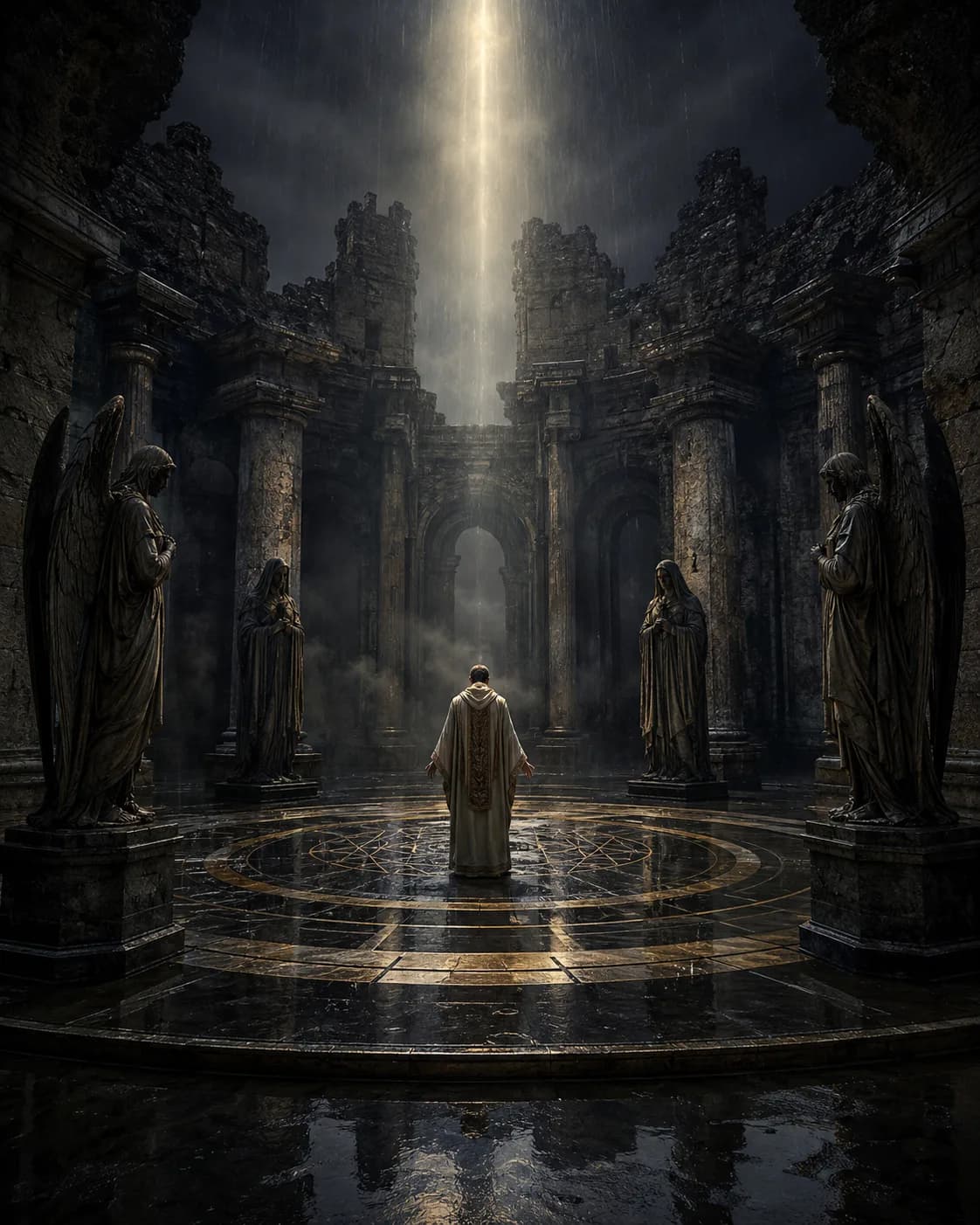
A robed figure standing inside a gilded circle inscribed on wet marble, veiled and winged statues surrounding the platform under a shaft of rain-lit sky

The Current

Western Esotericism

A scholarly umbrella for currents of hidden, initiatic, and alternative knowledge.

Not one tradition but a current running through many: Hermetic, Neoplatonic, Kabbalistic, alchemical, Rosicrucian, Masonic. What holds them together is less a doctrine than a habit of reading the world as legible.

Topic archive

Reading Western Esotericism

A dossier on Western esotericism — the family of currents assembled into a "tradition" by the Renaissance, dispersed through the modern occult, and reconstituted since 1979 as a field of study.

The site favors documented history, source literacy, and responsible interpretation.

Western esotericism is not one tradition but a family of currents — Hermetic, gnostic, kabbalistic, alchemical, theosophical, initiatic — that came, at a datable moment, to be read as one; this dossier maps both the currents and the reading.

The 'single unbroken lineage' running from Egypt to the present is itself a historical artefact, assembled in Florence in the 1460s around the idea of a prisca theologia; the construction must be described, and cannot honestly be repeated.

Since 1979 the subject has also been an academic discipline, with chairs at Paris and Amsterdam and a working definition — Faivre's four characteristics — which the archive treats as a finding aid rather than a creed.

The Map of the Current

How the subjects feed one another

A solid line is documented transmission — texts translated, teachers read, charters issued. A dashed line is descent as it was claimed, or influence too diffuse to footnote. Read left to right and one thing becomes visible: almost every solid path runs through the Renaissance synthesis — because the “single unbroken tradition” was assembled there, not inherited. The gold-edged nodes are doors to this archive’s own pages.

ANTIQUITYMEDIEVALRENAISSANCEEARLY MODERN19TH CENTURY20TH – NOWHermeticaRoman EgyptGnosis2nd–4th c.Neoplatonism& theurgyHellenisticastrologyGreco-EgyptianalchemyKabbalahProvence · CastileArabictransmissionBaghdad · al-AndalusThe synthesisFicino · Pico, 1462–86Christian CabalaReuchlin, 1517AgrippaDe occulta, 1533Paracelsismchemical medicineRosicrucianmanifestos1614–16Böhme'stheosophyAurora, 1612FreemasonryGrand Lodge, 1717Mesmerism &spiritualismTheosophicalSociety1875Golden Dawn1888Modern orders& currentsThe academyFaivre, 1979 · 1992

Simplifications, knowingly made: the Arabic transmission node stands for three centuries of translation in Baghdad and al-Andalus; Böhme owed the Rosicrucians nothing but arrived beside them; and the academy’s dashed line means it studies the current — it does not continue it.

Dossier

The Western Esotericism dossier

Core Motif

The recurring gesture across every current is genealogical: a claim to knowledge at once older than scripture, higher than doctrine, and transformative of its knower — and the assembling of disparate texts into the pedigree that claim requires.

A claimed knowledge older than scripture and higher than doctrineConcordance: disparate sources read as one perennial wisdomTransmission imagined as lineage, master to pupil, seal to sealCorrespondence binding cosmos, text, and soul into one legible orderEach revival rediscovering an 'original' behind its predecessors

Current, not Conspiracy

What actually persists is philological — manuscripts copied, translated, printed, and re-read — while the lineages are repeatedly invented after the fact; the honest history distinguishes the transmission of texts from the construction of tradition, and finds the second as instructive as the first.

Texts travelled; the 'tradition' was assembled around them afterwardsContinuity is manuscript and print, not institution or successionInvented lineages — Rosicrucian, Masonic, Theosophical — are facts about their inventors' presentNo hidden college steered the currents; translation, patronage, and polemic didRupture is as characteristic as survival: Casaubon's redating, the Enlightenment's exclusions

Aetherica Use

This dossier is the archive's hub: the page from which the Hermetic, gnostic, kabbalistic, alchemical, Rosicrucian, Masonic, and Theosophical dossiers can be reached, compared, and heard in their historical order rather than their mythical one.

Episode discoveryTranscript searchComparative diagramsSource listsCross-dossier navigation

Systems and Types

Cosmology / Metaphysics

Ancient matrices

In Roman Egypt and the Greek east, three distinct milieux — the Hermetic treatises, the gnostic scriptures, and the Neoplatonic defence of theurgy — furnish the raw material of everything that follows. They overlapped in vocabulary more than in membership, and were not yet a tradition; their unification lies over a millennium ahead.

Anatomy of the Current

01Gnosis above discursive reason
02A cosmos of sympathies and powers
03Descent and reascent of the soul
04Ritual as the completion of philosophy

Representative Texts

Corpus HermeticumNag Hammadi codicesIamblichus, De mysteriis

Comparative Architecture

A scanning view of the page's major systems, with each tradition kept distinct before deeper archive links, diagrams, and source notes are added.

SystemPeriodArchitectureTexts
Ancient matricesc. 100–400 CEGnosis above discursive reason -> A cosmos of sympathies and powers -> Descent and reascent of the soul -> Ritual as the completion of philosophyCorpus Hermeticum, Nag Hammadi codices, Iamblichus, De mysteriis
Medieval transmissions8th–14th centuriesCelestial causation and elected times -> Transmutation of matter and of self -> Sefirotic emanation -> Correspondence of letter, number, and worldPicatrix (Ghāyat al-Ḥakīm), Sefer ha-Zohar, Turba Philosophorum
Renaissance synthesis1462–1600Prisca theologia: one wisdom behind many names -> Concordance of Plato, Moses, and Hermes -> Natural magic as operative philosophy -> Man as nodal point between the worldsFicino's Pimander (1471), Pico, Conclusiones (1486), Agrippa, De occulta philosophia (1533)
Early modern currents1520s–1780sChemical philosophy of macrocosm and microcosm -> Signatures legible in nature -> God known through self-revelation in nature and soul -> Initiatic brotherhood and graded degreesBoehme, Aurora (1612), Fama Fraternitatis (1614), Anderson's Constitutions (1723)
Occult revival and the academy1875–presentAncient wisdom recast as occult science -> Comparative synthesis of East and West -> Initiation systematized into curricula -> Esotericism as an object of historical studyBlavatsky, The Secret Doctrine (1888), Faivre, Access to Western Esotericism (1994), Dictionary of Gnosis and Western Esotericism (2005)

Working Glossary

The vocabulary this dossier uses, with the register each definition belongs to. Terms the archive has spoken about link into transcript search; terms treated more fully on this page point there instead.

Esotericism

French, 1828

A noun younger than most of what it names: French ésotérisme is first attested in 1828, in Jacques Matter's history of Gnosticism, and the word designates a modern grouping of currents rather than a term those currents used of themselves.
Search the archive
Correspondences

Faivre, 1992

Faivre's first characteristic: the doctrine that all levels of the cosmos mirror and signify one another, so that stars, stones, scriptures, and souls can be read across.
Search the archive
Living nature

Faivre, 1992

The second characteristic: a cosmos understood as animate and traversed by sympathies, to be known by participation rather than dissection.
Search the archive
Mediation and imagination

Faivre, 1992

The third characteristic: access to the higher through intermediaries — images, symbols, angels, rites — grasped by a trained imagination treated as an organ of cognition rather than fancy.
Search the archive
Transmutation

Faivre, 1992

The fourth characteristic: the expectation that esoteric knowledge changes its knower — the alchemical metamorphosis of the soul, not merely of metal.
Search the archive
Prisca theologia

Latin

The Renaissance thesis of one ancient theology handed down from Zoroaster or Hermes through Orpheus and Pythagoras to Plato — the intellectual machinery by which the 'single tradition' was built.
Search the archive
Rejected knowledge

Scholarly

Hanegraaff's name for what esotericism became after the Enlightenment: the category of everything polite learning discarded, whose contents thereby acquired their family resemblance.
Search the archive

Chronology

Each period is drawn to its extent on one shared axis, so a three-hundred-year epoch runs three times the length of a hundred-year one. The boundaries are conventional rather than exact: a bar marks where the surviving evidence sits, not the year a tradition began or stopped. The empty stretches are part of the record — but a gap here means this dossier holds nothing in that interval, not that nothing happened in it.

Navigator

Select a period to travel to it

The strip draws every period to scale on one axis.

100 CE50010001500present
  1. c. 100–300 CE

    100 CE – 300 CE

    The ancient matrices

    In Roman Egypt and the Greek east the Hermetica are composed and the gnostic scriptures multiply, and at the period's very edge, around 300, Iamblichus's De mysteriis mounts the Neoplatonic defence of theurgy — three distinct milieux, not yet a tradition, that will furnish later centuries with their raw material.

    These milieux shared vocabulary more than membership; reading them as one movement is the later construction this dossier describes.

    Fixed points

    • Corpus Hermeticum composed, c. 100–300 CE
  2. Gap · 300 CE750 CE · 450 years

    The centuries between the last pagan schools and Baghdad are transmission, not silence: Byzantine copyists, Syriac translators, and the Harranian milieu carried the texts that the Abbasid capital would receive.

    8th–13th centuries

    750 CE – 1280

    Arabic learning and Latin translation

    Astrology and alchemy are elaborated in Arabic at Baghdad and Harran and return to Europe through the translators of Toledo and Sicily — the Picatrix, the Emerald Tablet, and the astrological corpus arriving in Latin dress as natural knowledge, not forbidden lore.

    Fixed points

    • Castilian Picatrix commissioned by Alfonso X, 1256
  3. c. 1280–1305

    1280 – 1305

    The Zohar in Castile

    Moses de León circulates the Zohar under a pseudepigraphic attribution to the second-century Shimon bar Yochai — kabbalah's sefirotic architecture given its central scripture, and an early model of antiquity claimed for a contemporary work.

    The attribution was already doubted by contemporaries; Gershom Scholem's demonstration of de León's authorship is the modern consensus.

  4. Gap · 13051471 · 166 years

    The interval since the Zohar is manuscript transmission — Latin alchemical pseudepigrapha circulating steadily, and Byzantine émigrés such as Plethon carrying Plato and the Chaldean Oracles west to Florence.

    1471

    1471

    Ficino's Pimander

    Marsilio Ficino, instructed by Cosimo de' Medici in 1463 to set Plato aside for Hermes, completes the Latin Corpus Hermeticum that reaches print at Treviso in 1471 — the moment the prisca theologia acquires its founding text, and the moment the 'ancient unbroken tradition' begins to be assembled rather than inherited.

    Fixed points

    • Ficino completes the translation, 1463
  5. 1486

    1486

    Pico's nine hundred theses

    Giovanni Pico della Mirandola publishes his Conclusiones, drawing Christian doctrine, kabbalah, and Hermetic philosophy into one proposed concordance; Rome condemns thirteen theses, and the syncretic method survives the censure to become the tradition's engine.

  6. Gap · 14861533 · 47 years

    1533

    1533

    Agrippa printed in full

    The complete De occulta philosophia appears at Cologne, ordering natural, celestial, and ceremonial magic into a three-storey architecture — the Renaissance synthesis made portable, and the occult library's most reprinted handbook thereafter.

  7. Gap · 15331612 · 79 years

    1612–1616

    1612 – 1616

    Theosophy and the Rosicrucian moment

    Boehme's unfinished Aurora (1612) begins German theosophy; the Fama and Confessio (1614–1615) announce an invisible brotherhood that never existed as described; and in the same years Casaubon's redating of the Hermetica (1614) strips Hermes of his antiquity. The invented lineage and its philological undoing are exact contemporaries.

    Fixed points

    • Fama Fraternitatis printed, 1614
    • Casaubon's De rebus sacris, 1614
  8. Gap · 16161717 · 101 years

    1717

    1717

    The Grand Lodge

    Four London lodges federate as a Grand Lodge — 1717 by the traditional account, though recent scholarship has argued for 1721 — and speculative Freemasonry organizes initiatic brotherhood into a durable institution whose degrees carry esoteric symbolism across the eighteenth century.

  9. Gap · 17171875 · 158 years

    The interval since 1717 is not a void: Masonic high degrees, Swedenborgians, Mesmerists, and French illuminists kept the currents moving while Enlightenment polemic was redefining them as rejected knowledge.

    1875–1888

    1875 – 1888

    The occult revival

    The Theosophical Society (New York, 1875) and the Hermetic Order of the Golden Dawn (London, 1888) recast the older currents as occult science and graded curriculum — Blavatsky's hidden Masters and the Golden Dawn's charter from an untraceable German adept each supplying a lineage its own historians cannot find.

    Fixed points

    • Theosophical Society founded, 1875
    • Isis-Urania Temple opened, 1888
  10. Gap · 18881979 · 91 years

    1979–1999

    1979 – 1999

    The academy arrives

    Antoine Faivre takes the Sorbonne chair in the history of esoteric currents in 1979, and in 1992 publishes the four intrinsic characteristics — correspondences, living nature, imagination and mediation, the experience of transmutation — that give the field its working definition; in 1999 Wouter Hanegraaff's Amsterdam chair gives it a second centre.

    Frances Yates's Giordano Bruno and the Hermetic Tradition (1964) had prepared the ground, though her 'Hermetic tradition' is precisely what the newer scholarship has qualified.

    Fixed points

    • Faivre's L'ésotérisme, 1992
    • Amsterdam chair founded, 1999
  11. 1999–present

    1999 – present

    A field, not a lineage

    The discipline consolidates — journals, learned societies, the Dictionary of Gnosis and Western Esotericism (2005) — while its central finding stands: the currents are real and datable, the single secret tradition was a Renaissance construction, and the history of that construction is itself the subject.

Prominent Figures

Marsilio Ficino

1433–1499

Translator of Plato and the Hermetica whose Pimander of 1471 gave the prisca theologia its charter and the 'ancient tradition' its founding assembly.

Giovanni Pico della Mirandola

1463–1494

Author of the nine hundred theses of 1486, who bound kabbalah into the Christian syncretism and made concordance the tradition's working method.

Heinrich Cornelius Agrippa

1486–1535

Systematizer whose De occulta philosophia, printed in full in 1533, fixed the three-world architecture of Renaissance magic for every later revival.

Jacob Boehme

1575–1624

Görlitz shoemaker whose Aurora of 1612 founded Christian theosophy and supplied later esotericism with its language of divine self-revelation in nature and soul.

Helena Petrovna Blavatsky

1831–1891

Co-founder of the Theosophical Society in 1875, whose synthesis of Western occultism and Indian thought remade the currents for the modern world — on the authority of Masters and sources her historians cannot locate.

Frances Yates

1899–1981

Warburg historian whose Giordano Bruno and the Hermetic Tradition (1964) made the Renaissance synthesis a respectable object of study, and whose grand 'Hermetic tradition' the field has since carefully qualified.

Antoine Faivre

1934–2021

Holder from 1979 of the Sorbonne chair in the history of esoteric currents — a chair founded in 1965 for the history of Christian esotericism and renamed for his tenure — whose four characteristics of 1992 gave the discipline its working definition.

Wouter Hanegraaff

b. 1961

Holder of the Amsterdam chair from 1999; historian of the field's own construction, who reframed esotericism as the West's 'rejected knowledge'.

Source Texts

Corpus Hermeticum

Hermetic

Seventeen Greek treatises of Roman Egypt, c. 100–300 CE — the tradition's imagined fountainhead, and in fact its late-antique anthology.

Picatrix (Ghāyat al-Ḥakīm)

Arabic astral magic

Tenth- or eleventh-century Arabic compendium of astral magic, translated into Castilian at Alfonso X's court in 1256, the Latin version deriving from it; the principal channel of talismanic theory into Europe.

Sefer ha-Zohar

Kabbalah

Circulated in Castile from the 1280s by Moses de León under a second-century attribution — kabbalah's central scripture, and a study in claimed antiquity.

De occulta philosophia

Renaissance magic

Agrippa's three books, drafted by 1510 and printed in full in 1533; the synthesis's most influential and most reprinted handbook.

Fama Fraternitatis

Rosicrucianism

Anonymous manifesto of 1614 announcing a brotherhood that existed only on paper — the clearest case of an invented lineage generating a real current.

The Secret Doctrine

Theosophy

Blavatsky's synthesis of 1888, built on the Stanzas of Dzyan, a source no scholar has located; the occult revival's summa.

Dictionary of Gnosis and Western Esotericism

Scholarship

The reference work edited by Hanegraaff and colleagues in 2005 — the field's map of the currents this archive follows, dossier by dossier.

Editorial Note

This dossier is an Aetherica editorial research layer. It is designed to support deeper pages, archive search, future bibliographies, and interactive diagrams. Historical claims, symbolic readings, and modern esoteric interpretations should remain clearly labeled as the library expands.

Continue

Adjacent currents