Core Motif
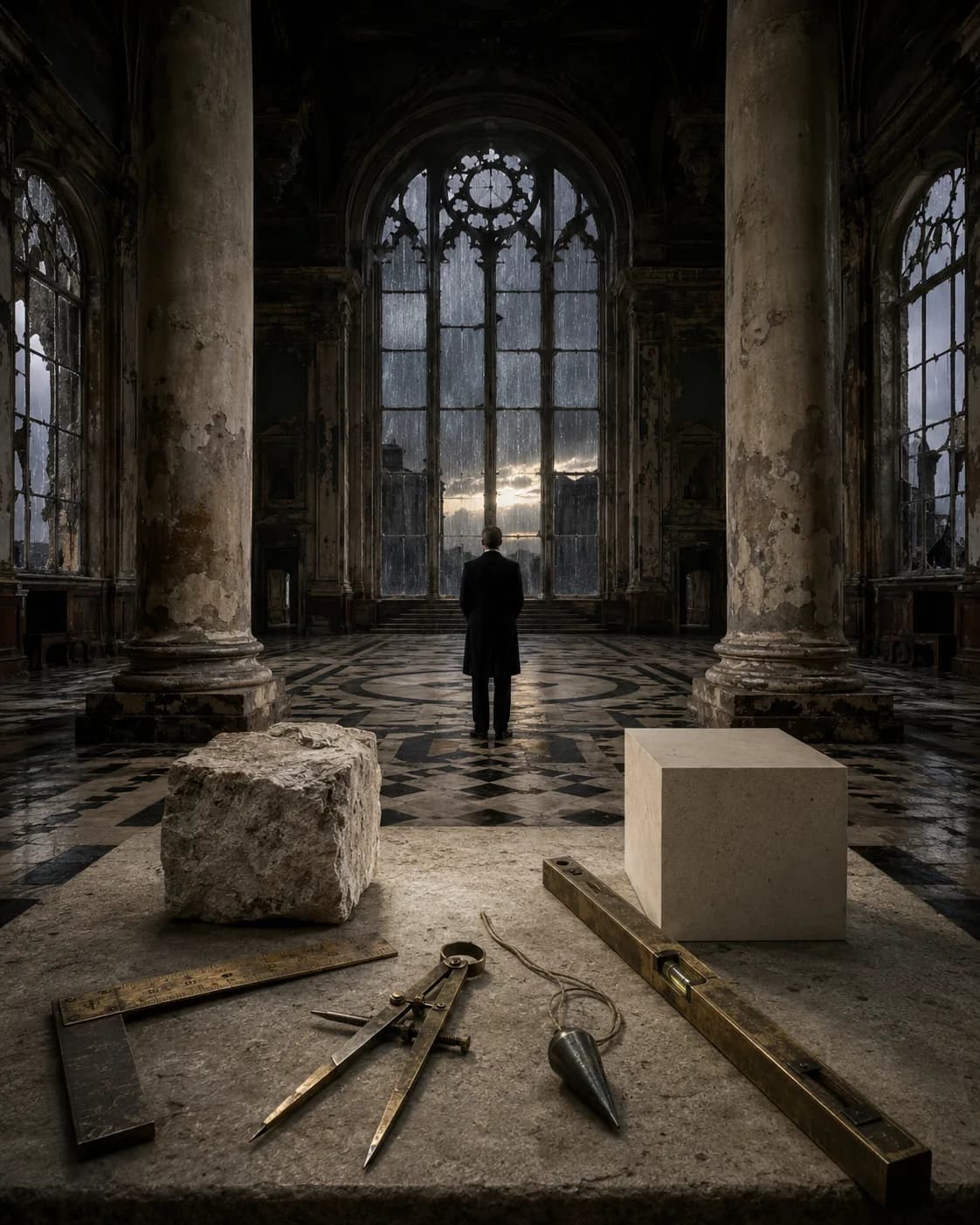
The building site as a school: a man is his own rough ashlar, and the tools of measurement become instruments of judgment.
Rough and perfect ashlarSquare and compassesThe lodge as diagramBuilding as self-formation
Ars Regia
An initiatic fraternity with symbolic, architectural, and moral teachings.
The rough ashlar and the perfect ashlar are the same stone at two moments. Every working tool on the pavement is an instrument of measurement before it is a symbol of anything.
Topic archive
A dossier on the Craft: operative roots, the grand lodge system, the rites and their degrees, and the long history of schism, recognition, and controversy.
The Chamber of Reflection
Coverage emphasizes symbolism, history, ritual architecture, and documented sources.
Freemasonry is not one organization. It is a network of sovereign grand lodges, each supreme in its own territory, held together — and divided — by a system of mutual recognition. Two Masons from opposite ends of the earth may sit in the same lodge, or be forbidden to, depending on whether their grand lodges recognize one another.
The Craft's documented history runs from medieval operative stonemasons' regulations, through the admission of non-masons in the seventeenth century, to the founding of the first Grand Lodge in 1717 and everything that followed: rival rites, schisms, exposures, a kidnapping that birthed an American political party, and a French split that still divides the fraternity today.
This page keeps the strands distinct: the three Craft degrees that everything else presupposes, the appendant rites built above them, the separate and parallel histories of Prince Hall and Continental Masonry, and the difference between what grand lodges call regular, irregular, and clandestine.
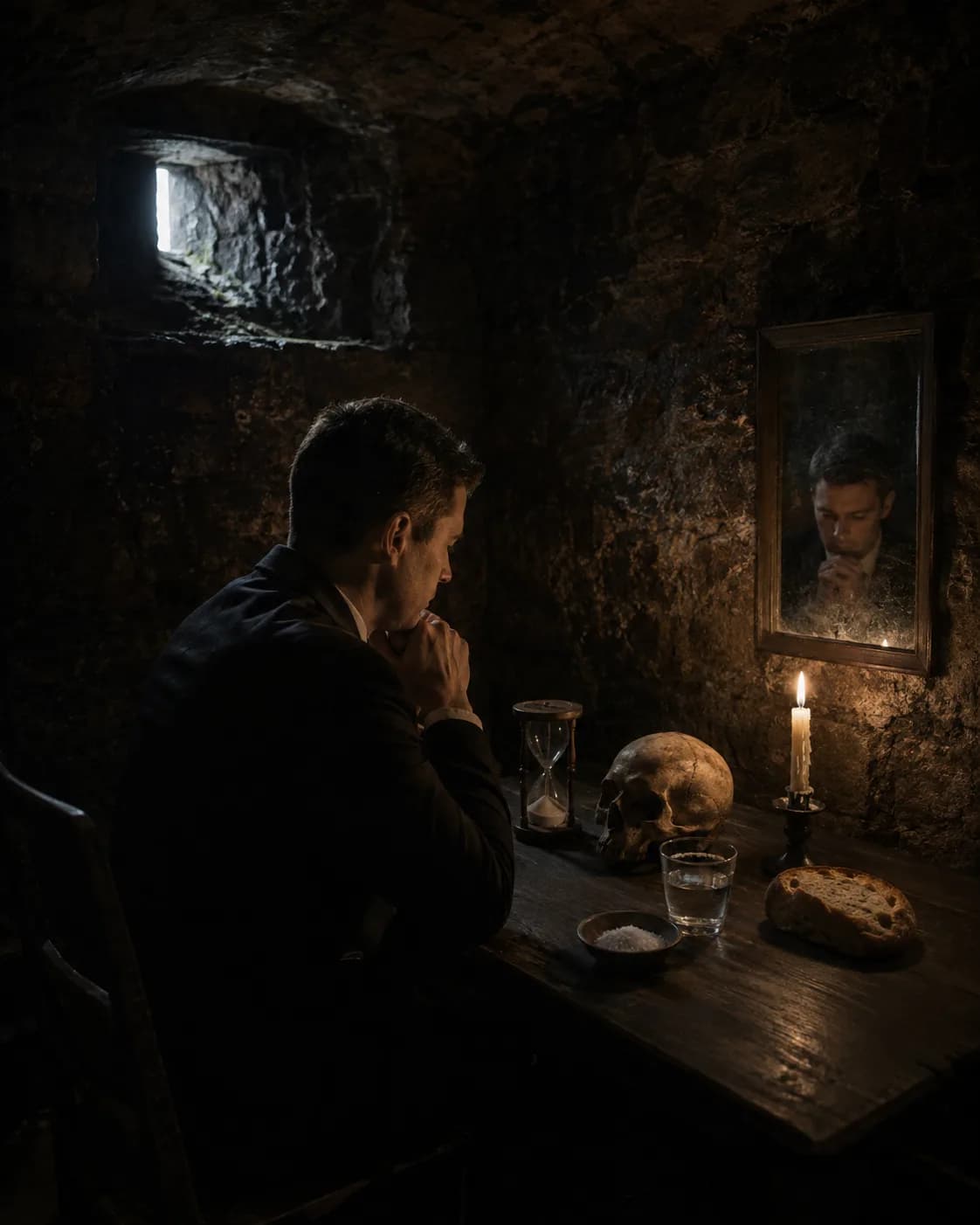
In many rites the candidate waits alone in a small dark room before initiation: skull, hourglass, bread, salt, and a mirror. Nothing is taught there. The chamber only arranges a man, his time, and his face — and lets him draw his own conclusions.
The Rites
Every branch of Freemasonry stands on the same three Craft degrees, and none outranks them: a 32° Scottish Rite Mason holds no authority over a Master Mason in a Craft lodge — the numbers count degrees received, not command. The rites are best read as separate towers raised on one shared foundation, each telling its own continuation of the story the third degree leaves deliberately unfinished.
York Rite
a federation of bodies
Royal Arch Chapter
Capitular degrees
The recovered Word — completing, in its own account, the story the third degree leaves broken.
Cryptic Council
Cryptic degrees
The vault beneath the temple: preservation of the Word before its loss.
Knights Templar Commandery
Chivalric orders
Christian orders of knighthood — the one branch requiring a profession of faith.
Scottish Rite (AASR)
Supreme Councils, from 1801
Lodge of Perfection
4° – 14°
The 'ineffable' degrees, elaborating the Hiramic legend.
Chapter of Rose Croix
15° – 18°
Degrees of the new law, culminating in the Rose Croix.
Council of Kadosh
19° – 30°
Philosophical and chivalric degrees of the rite.
Consistory
31° – 32°
The Royal Secret; the 33° is conferred as an honor, not earned by advancement.
The Craft — Blue Lodge
I
Entered Apprentice
The rough ashlar
II
Fellow Craft
The winding stair
III
Master Mason
The legend of Hiram
Conferred in a local lodge under a grand lodge’s warrant. Everything above presupposes these three; nothing above outranks them.
Alongside the rites stand the appendant and allied bodies — Shrine, Grotto, the Order of the Eastern Star — social and charitable orders requiring Craft membership (or, for the Eastern Star, kinship to a Mason). Prince Hall Masonry maintains this same architecture in full: its own grand lodges, chapters, councils, commanderies, and consistories.
There is no worldwide Masonic authority. Each grand lodge is sovereign in its territory, and the fraternity coheres — where it does — through treaties of mutual recognition. Every schism in the dossier below is visible as a recognition event: the Antients warring with the Moderns, the 1877 withdrawal from the Grand Orient, and the two centuries in which Prince Hall grand lodges were refused the recognition their descent plainly merited.
Each degree hands the candidate the instruments of a real building site and then turns them over: the operative use first, the moral application second. The jewels the three principal officers wear are the Fellow Craft’s tools — square, level, and plumb — which is the system saying, in its own emblem language, that authority is a form of measurement.
Entered Apprentice
24-inch Gauge
measures the work
the day portioned — labour, refreshment, service
Common Gavel
knocks off knobs and excrescences
breaking from the stone of self what disfigures it
Chisel
smooths and prepares the stone
discipline bringing the hidden figure out
Fellow Craft
Square
tries right angles
squaring actions — the rule of morality
Level
proves horizontals
equality: all meet upon the level
Plumb Rule
tries uprights
uprightness of life before all
Master Mason
Skirret
strikes the centre line of a foundation
conduct laid out straight from the centre
Pencil
draws the design
every deed drawn, and recorded
Compasses
sets out proportions and limits
desire kept within due bounds
The allocation above is the English working. American Craft ritual gives the Master Mason a single tool instead — the trowel, for spreading the cement of brotherly love.
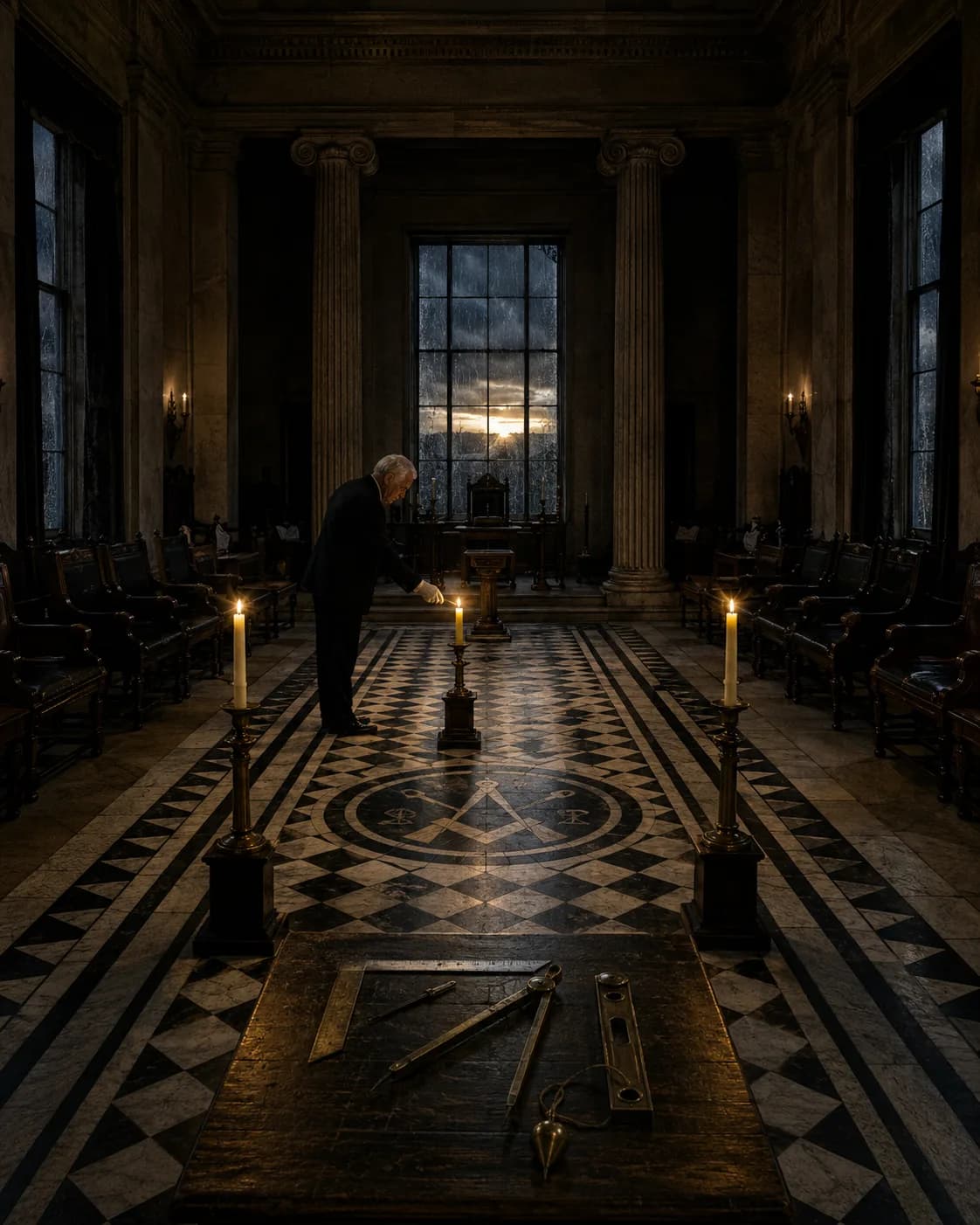
A lodge room is laid out as a model of the world: oriented east to west as temples anciently were, the mosaic pavement underfoot for the dualities every life walks across, the starry heavens for a ceiling. The Master rules from the East where light rises; the Wardens mark the sun’s setting and its meridian; the Tyler stands outside a guarded door. The three tapers about the altar are the lesser lights — Sun, Moon, and Master of the lodge.
The plan is schematic — an English-pattern lodge at labour. The paired circles at the door are the pillars of the porch; their letters belong to the ritual, not to a diagram.
WMWorshipful Master
rules the lodge from the East; jewel, the Square
SWSenior Warden
the West, marking the setting sun; jewel, the Level
JWJunior Warden
the South, the sun at meridian; jewel, the Plumb
SD · JDDeacons
messengers between the principal officers, bearing wands
IGInner Guard
within the door (English working)
TylerTyler
outside the door with a drawn sword, against cowans and eavesdroppers
The Lodge at Labour
A lodge is not the building but the men assembled; the room is furnished so that everything in sight — pavement, pillars, lights, tools — can be read. When the candles are lit, the room becomes a diagram the meeting sits inside.
Dossier
Core Motif
The building site as a school: a man is his own rough ashlar, and the tools of measurement become instruments of judgment.
Regular and Clandestine
Recognition is the fraternity's constitutional machinery — and the word 'clandestine' is a term of art, not an insult.
Aetherica Use
The topic gathers episodes on Masonic history, ritual, symbolism, and the Craft's entanglement with the wider esoteric current.
Cosmology / Metaphysics
The foundation everything else presupposes: three degrees conferred in a local lodge under a grand lodge's warrant. Whatever else a Mason joins, he is made here.
Degree Architecture
Representative Texts
A scanning view of the page's major systems, with each tradition kept distinct before deeper archive links, diagrams, and source notes are added.
| System | Period | Architecture | Texts |
|---|---|---|---|
| Craft (Blue Lodge) Masonry | 1717-present | Entered Apprentice — the rough ashlar -> Fellow Craft — the winding stair -> Master Mason — the legend of Hiram -> No higher authority than the third degree | Anderson's Constitutions (1723), Preston, Illustrations of Masonry, Emulation and Webb-form rituals |
| York Rite | 18th century-present | Royal Arch — the recovered Word -> Cryptic degrees — the vault -> Templar orders — chivalric Christianity -> A federation, not a single body | Webb, Freemason's Monitor (1797), General Grand Chapter constitutions |
| Scottish Rite (AASR) | 1801-present | Lodge of Perfection, 4-14 -> Rose Croix, 15-18 -> Council of Kadosh, 19-30 -> Consistory 31-32; the 33rd honorary | Grand Constitutions of 1786, Pike, Morals and Dogma (1871) |
| Prince Hall Masonry | 1775-present | African Lodge No. 459 -> A parallel grand lodge network -> Recognition withheld for two centuries -> Mutual recognition spreading since 1989 | African Lodge charter (1784), Prince Hall's charges of 1792 and 1797 |
| Continental (Liberal) Masonry | 1877-present | Absolute liberty of conscience -> Adogmatic lodges -> Co-Masonry and women's obediences -> A rival definition of the Craft itself | Grand Orient constitution of 1877, Le Droit Humain founding documents (1893) |
The vocabulary this dossier uses, with the register each definition belongs to. Terms the archive has spoken about link into transcript search; terms treated more fully on this page point there instead.
Each period is drawn to its extent on one shared axis, so a three-hundred-year epoch runs three times the length of a hundred-year one. The boundaries are conventional rather than exact: a bar marks where the surviving evidence sits, not the year a tradition began or stopped. The empty stretches are part of the record — but a gap here means this dossier holds nothing in that interval, not that nothing happened in it.
12th-16th century
1150 – 1550
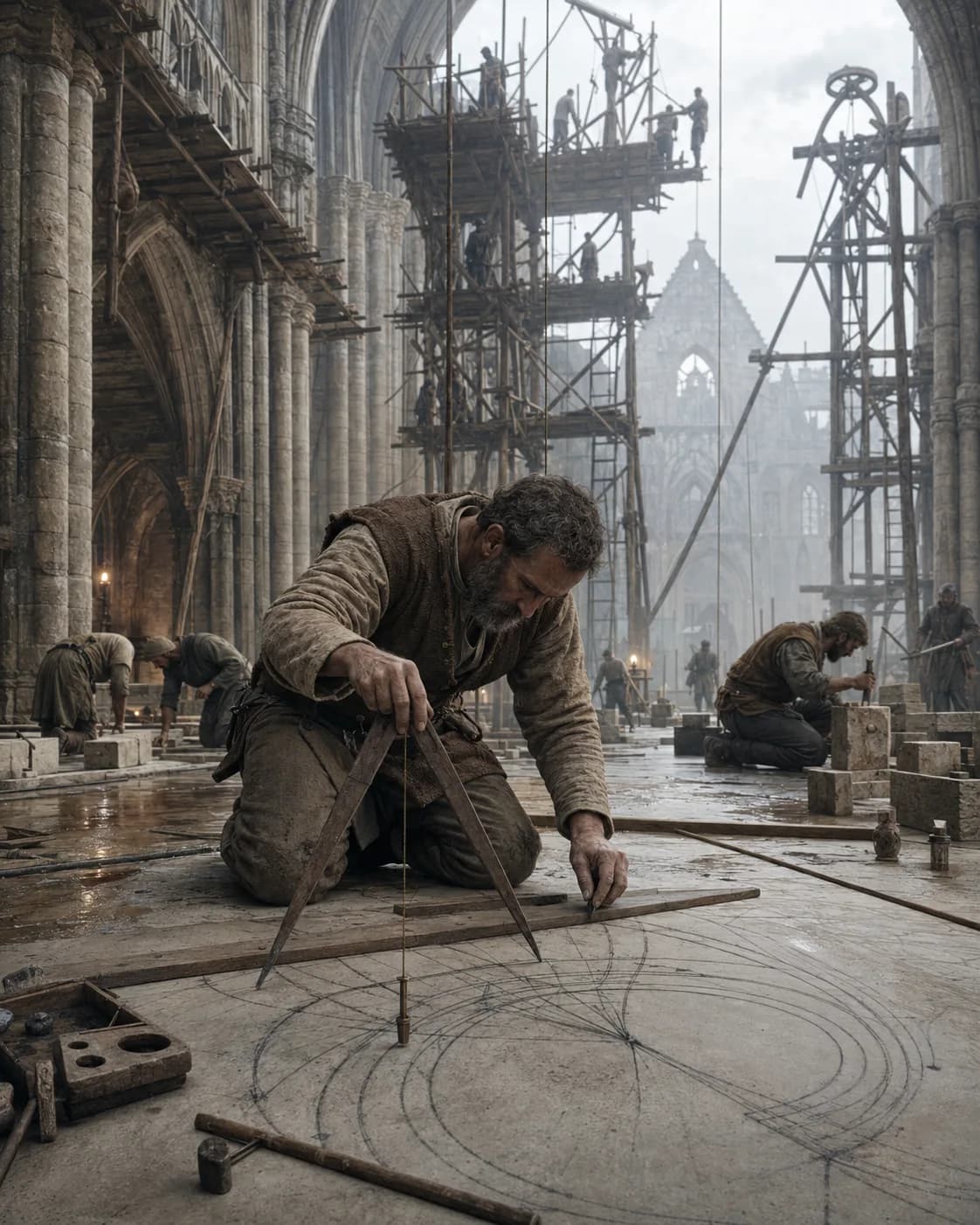
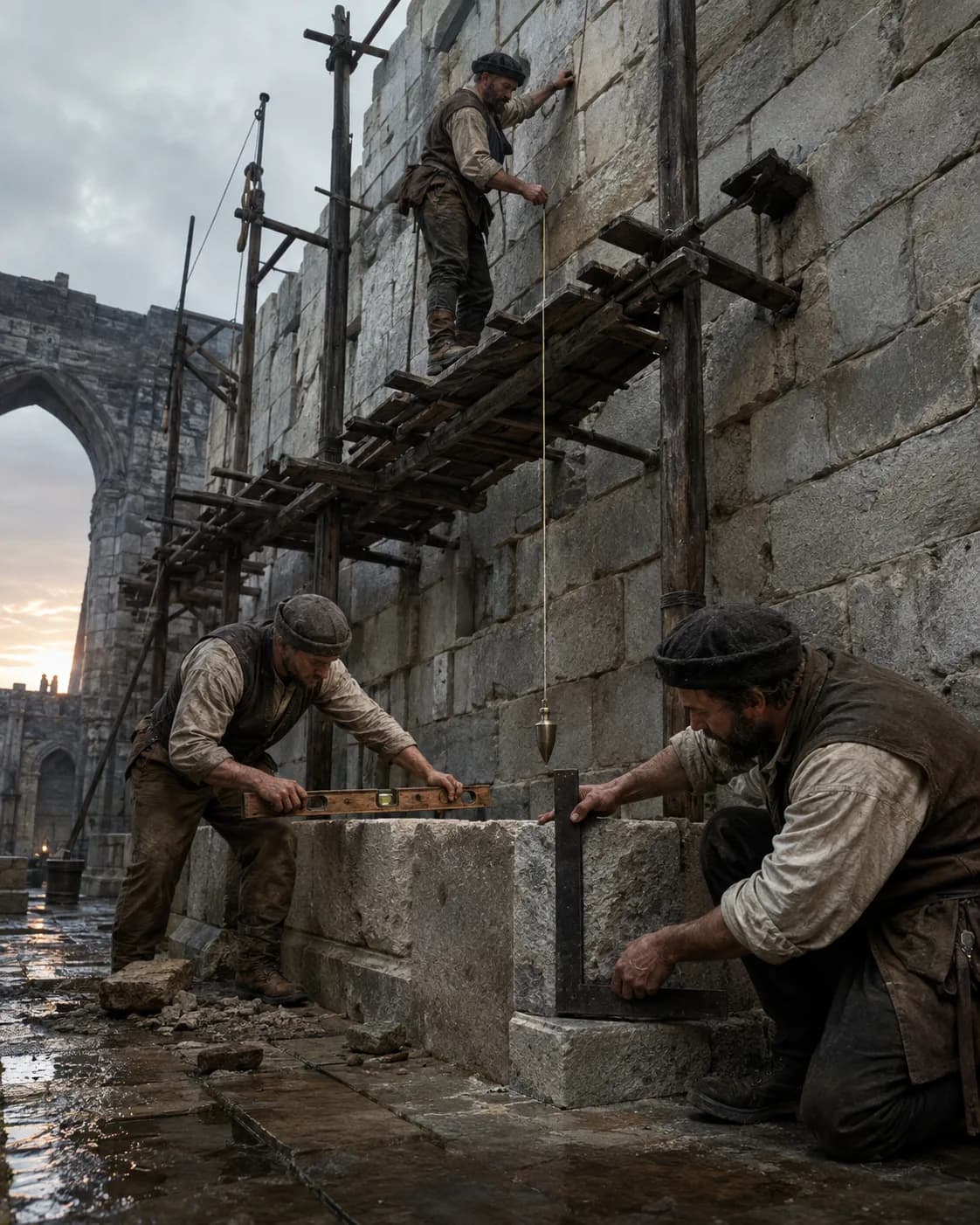
Masons building cathedrals and castles organize around the site hut — the lodge — with trade secrets, recognition tokens, and geometry passed master to apprentice. The tools later moralized were first simply used.
Fixed points
c. 1390
1390
The oldest of the Old Charges: rhymed regulations for the mason trade, opening with a legend that traces geometry from Euclid to England. Craft rules and craft myth are already bound together.
Dated on paleographic grounds; the Cooke manuscript follows c. 1410. More than a hundred Old Charges survive.
Fixed points
Gap · 1550 – 1598 · 48 years
1598-1599
1598 – 1599
William Schaw, Master of Works to the Scottish crown, issues statutes organizing Scotland's lodges as permanent institutions with records — the earliest lodge minutes in the world begin here.
Fixed points
17th century
1600 – 1717
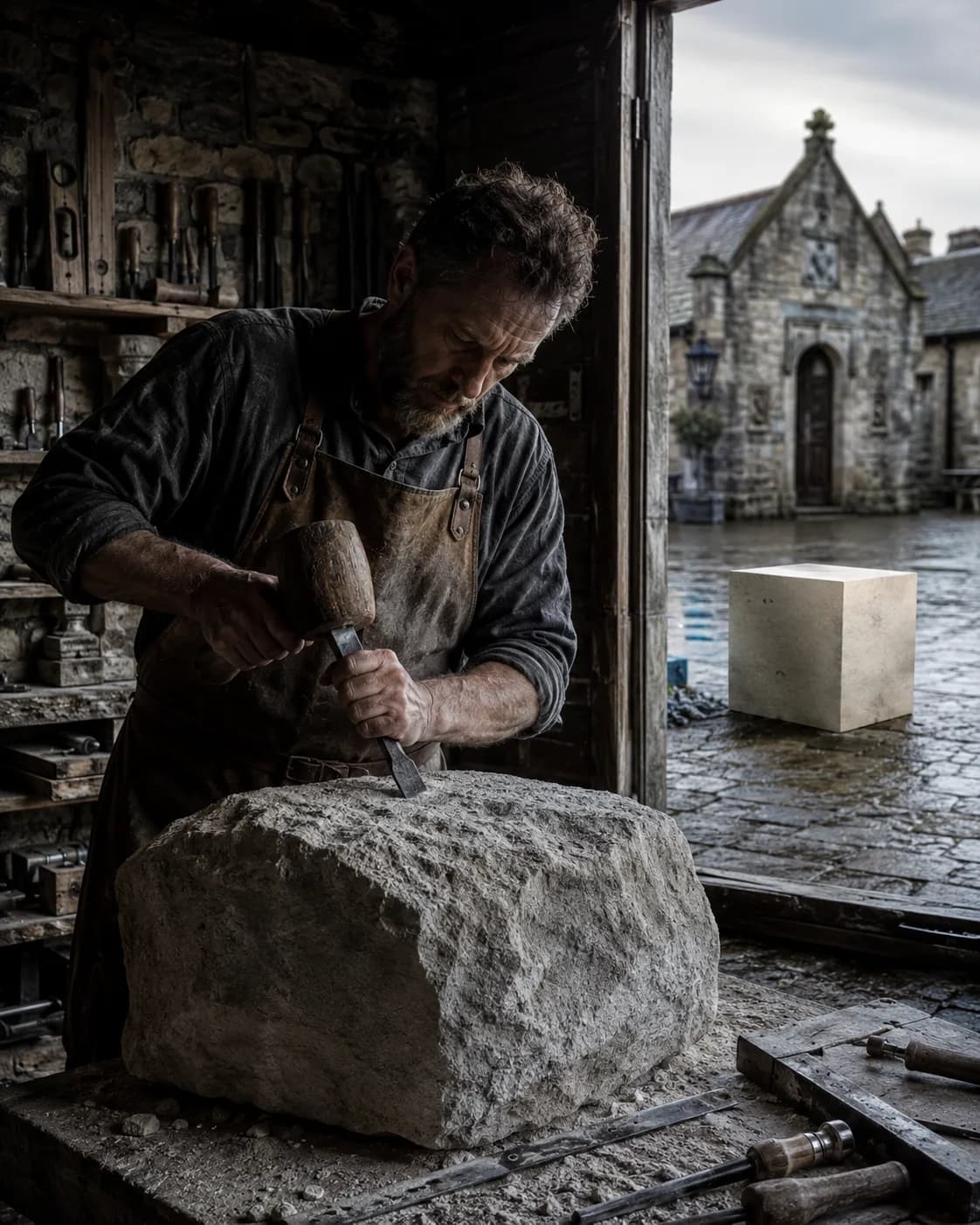
Gentlemen with no trade connection begin joining operative lodges — 'accepted' masons. Why they wanted in, and what the lodges gave them, is the hinge question of Masonic historiography.
Fixed points
1717
1717
Four London lodges meeting at the Goose and Gridiron alehouse form a Grand Lodge and elect a Grand Master — the moment the Craft acquires a central institution, and the calendar every later history counts from.
Some scholarship argues for 1721 as the real institutional beginning, with 1717 back-dated by Anderson. The traditional date is kept here.
Fixed points
1730
1730
Samuel Prichard's Masonry Dissected sells out in days and prints the third-degree legend of Hiram Abiff for the first time — the murdered master builder, the lost word, the raising. The secret becomes the Craft's most public possession.
Fixed points
1751-1813
1751 – 1813
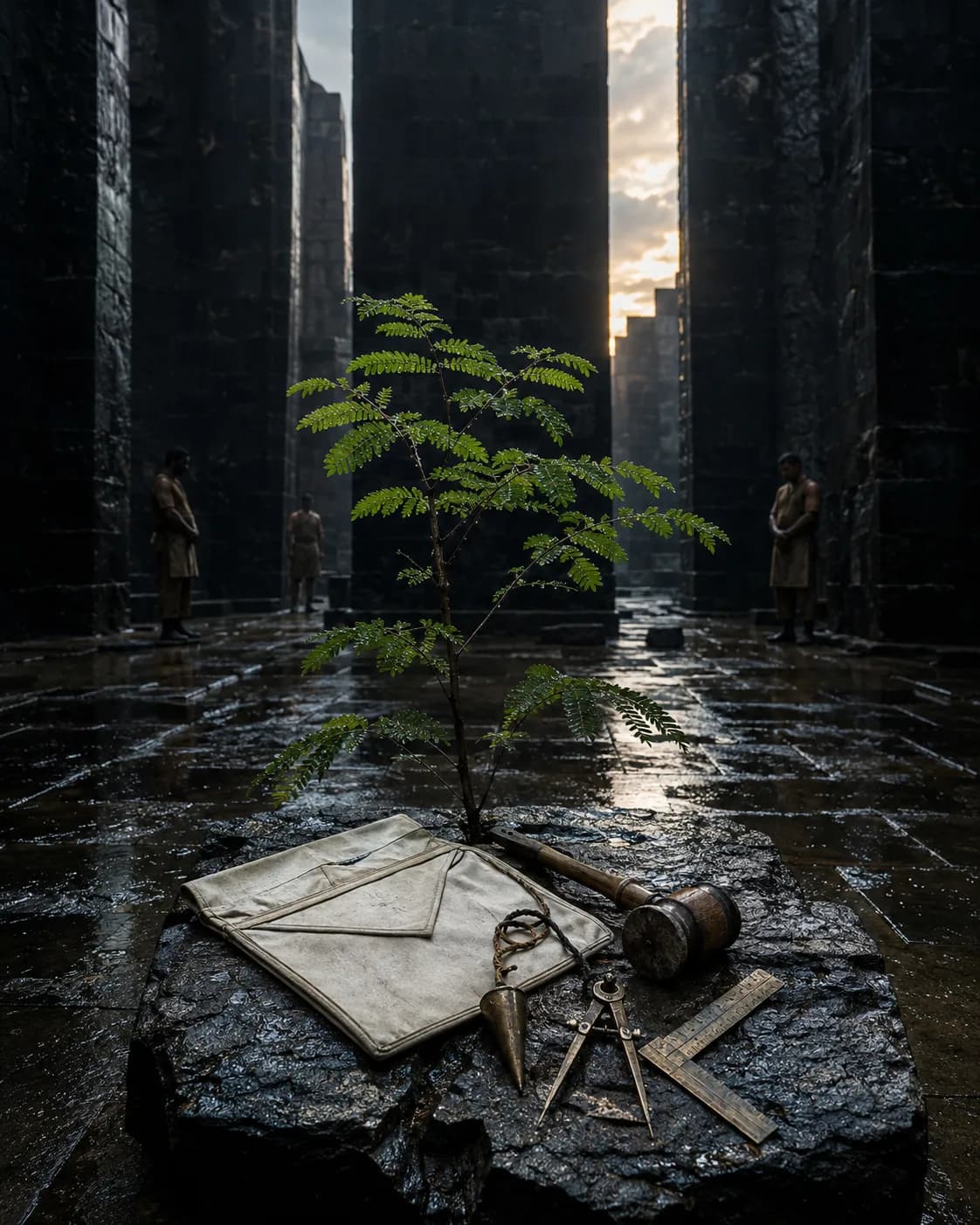
Irish Masons in London, shut out of the first Grand Lodge's circles, erect a rival 'Antient' Grand Lodge accusing the 'Moderns' of tampering with the ritual. Two grand lodges warrant lodges against each other for sixty years.
Fixed points
1775-1784
1775 – 1784
Prince Hall and fourteen other free Black men are initiated in a military lodge at Boston; refused by American grand lodges, they obtain a charter directly from London in 1784 as African Lodge No. 459 — the founding of a parallel Masonry that white American grand lodges would refuse to recognize for two centuries.
Fixed points
1813
1813
Antients and Moderns merge as the United Grand Lodge of England, standardizing ritual and defining the Craft as three degrees 'including the Holy Royal Arch.' The settlement still governs English Masonry.
Fixed points
1826-1840
1826 – 1840
William Morgan, about to publish an exposure in upstate New York, is abducted and never seen again. The scandal births the Anti-Masonic Party — the first third party in American politics — and halves American membership within a decade.
Fixed points
Gap · 1840 – 1877 · 37 years
1877
1877
The Grand Orient de France removes the requirement of belief in a Supreme Being, appealing to absolute liberty of conscience. Anglo-American grand lodges withdraw recognition — the schism that still divides world Masonry into 'regular' and 'liberal' families.
In grand lodge vocabulary, 'irregular' bodies depart from the landmarks; 'clandestine' ones lack lawful origin. Recognition, not ritual, is what the words track.
Fixed points
1893
1893
Le Droit Humain is founded in Paris as Co-Freemasonry, initiating women and men on equal terms after Maria Deraismes' initiation in 1882; women's grand lodges follow. Regular grand lodges do not admit women, and these obediences work outside recognition to this day.
Fixed points
Gap · 1893 – 1981 · 88 years
1981
1981
Italy's P2 lodge — expelled by the Grand Orient of Italy years earlier — is exposed as a covert political network implicated in finance scandals and subversion. The affair remains the modern touchstone for Masonic conspiracy, and the clearest case of a lodge operating clandestinely in the strict sense.
Fixed points
1989-present
1989 – present
Mainstream American grand lodges begin recognizing their Prince Hall counterparts, state by state — a process still incomplete in parts of the American South. The fraternity's oldest injustice is unwound through its own constitutional machinery.
Fixed points
1550-1602
Master of Works to James VI whose statutes made Scottish lodges permanent record-keeping institutions — the Craft's documented pre-history begins with him.
1617-1692
Antiquary and founding Royal Society fellow whose 1646 diary entry is the most famous early record of a gentleman's initiation.
c. 1679-1739
Presbyterian minister who compiled the 1723 Constitutions, replacing the old legendary histories with the Grand Lodge era's founding document.
c. 1735-1807
Abolitionist and founder of African Lodge No. 459, from which the entire Prince Hall grand lodge system descends.
1771-1819
Architect of the American York Rite: his Freemason's Monitor shaped the ritual worked in most United States lodges.
1809-1891
Sovereign Grand Commander who rewrote the Scottish Rite's degrees and whose Morals and Dogma made him both the rite's philosopher and the conspiracy literature's favorite quarry.
1828-1894
French feminist whose 1882 initiation broke the gender line and led to Co-Freemasonry's founding.
Old Charges
The oldest Masonic document: operative regulations in rhyme, with the craft's legendary history already attached.
Grand Lodge era
The 1723 founding text: charges, regulations, and a rewritten traditional history for the new institution.
Exposure
Prichard's 1730 exposure — hostile, bestselling, and the first print appearance of the Hiram legend. Historians rely on what the fraternity resented.
Craft
William Preston's 1772 systematization of Masonic lecture and ceremony, ancestor of most English-language ritual work.
Antient
Laurence Dermott's constitution for the rival Grand Lodge — polemical, funny, and the Antients' case in their own words.
Scottish Rite
Pike's 1871 degree commentary: a vast comparative-religion library, endlessly quoted and misquoted in controversy.
This dossier is an Aetherica editorial research layer. It is designed to support deeper pages, archive search, future bibliographies, and interactive diagrams. Historical claims, symbolic readings, and modern esoteric interpretations should remain clearly labeled as the library expands.
Continue