Rose and Cross
A careful home for theology, prayer, liturgy, angelology, and mystical texts.
Christian mysticism names an architecture rather than a mood: the conviction, worked out across two millennia of practice and argument, that the soul can be purged, illumined, and united to God, and that this passage has a grammar — one that can be taught, mapped in castles and ladders and nights, and also mislaid. Its classic instruments are few and remarkably stable: the threefold way, the discipline of attention inherited from the Egyptian desert, and the slow reading of Scripture until the text turns and reads the reader.
The tradition speaks two languages at once. The kataphatic names God through everything made and revealed; the apophatic unsays every name until the unsaying fails into what Dionysius called divine darkness — and between them runs a third, stranger idiom, the bridal reading of the Song of Songs, in which the soul is courted, wounded, and wed. Desert ascetics, Cistercian abbots, Beguine poets, Rhineland Dominicans, and Athonite hesychasts each weighted these languages differently, which is why the tradition is best read as five architectures under one roof rather than a single doctrine.
It is also a history of institutional friction, and this dossier declines to soften it. The church has depended on its mystics for the substance of its sanctity while suspecting them of dissolving the very mediations — sacrament, hierarchy, creed — on which it stands; the result is a record in which Porete is burned and quietly read, Eckhart condemned and quietly absorbed, Palamas attacked and made doctrine, Teresa investigated and made Doctor. The pattern is stated here as fact, not romance: the archive's interest is in how the tradition survived its own censures, and at what cost.
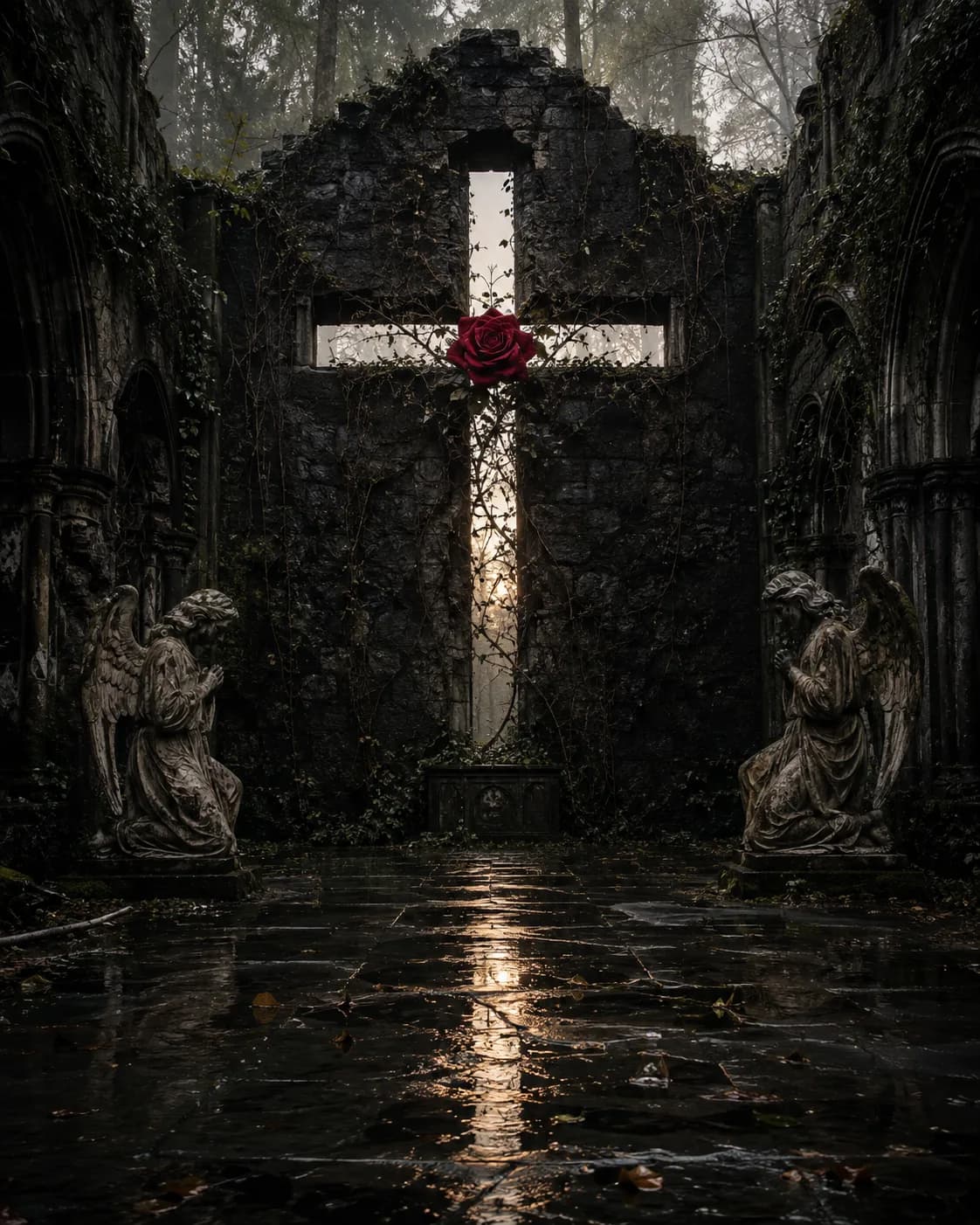
The rose upon the cross is a late emblem — seventeenth-century and Rosicrucian in its familiar form — but it condenses a much older claim: that the place of suffering and the place of flowering are the same place, and that the second is not a consolation added afterwards.